

You opened your mailbox, and there it is. An envelope from the Internal Revenue Service. Your stomach drops. You flip it over, tear it open, and see words like “examination” and “substantiation” and “mileage deduction.”
Deep breath. I’ve helped clients through dozens of these. Most mileage inquiries resolve without major issues—if you handle them correctly.
Here’s exactly what to do.
First: Figure Out What Type of Letter You Got
Not all IRS letters are created equal. The letter number (top right corner) tells you what you’re dealing with:
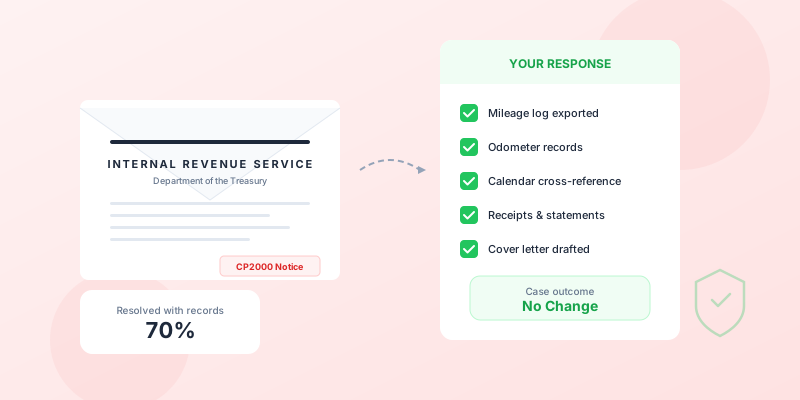
CP2000 — “We think you owe more” This is the most common one. The IRS compared your tax return to the information they received from third parties and found a discrepancy. Maybe you claimed 22,000 business miles but your 1099 data suggests that’s high. This isn’t an audit—it’s an automated notice. You have 30 days to respond.
Letter 566 or 4313 — Correspondence audit The IRS wants documentation for a specific deduction. They’re asking you to mail in proof. Still not a full audit. You typically get 30 days, sometimes 60.
Letter 2202 — In-person audit This is the real deal. They want you to come in (or send a representative) with your records. These are less common for mileage-only issues, but they happen—especially if the mileage deduction is large or part of a broader examination.
Letter 525 — General 30-day letter A proposed adjustment. The IRS has already reviewed something and wants to change your return. You can agree, partially agree, or dispute.
If your letter doesn’t match any of these, look up the notice number on IRS.gov/notices. Seriously—do this before anything else.
Don’t Panic. Most Mileage Inquiries Are Manageable
Here’s what I tell every client who calls me in a panic: the IRS isn’t trying to ruin your life. They want documentation. That’s it.
In my experience, about 70% of mileage-related correspondence audits are resolved with a written response and supporting documents. No meeting. No courtroom drama. You mail in your records, they review them, and you get a letter saying the matter is closed.
The key phrase: the quality of your records matters more than the amount you claimed. A rideshare driver can defend a $14,000 mileage deduction with solid GPS logs. A consultant can lose a $3,200 deduction because they had nothing but a sticky note that said “drove a lot for work.”
What Documentation to Gather
Start pulling these together immediately. Don’t wait until the deadline is close.
Your mileage log or tracking app data. This is the big one. Export everything—dates, destinations, distances, business purposes. If you used an automatic tracking app, export the full report. If you kept a paper log, make copies.
Your vehicle’s odometer readings. Beginning and end-of-year readings. If you don’t have them, check your oil change receipts, inspection records, or dealership service records. Most shops print the odometer on the invoice.
Calendar and appointment records. Cross-reference your mileage entries with your schedule. A mileage log that matches your Google Calendar is extremely compelling. “I drove to ABC Corp on March 12th” is stronger when your calendar shows “Meeting with ABC Corp, 10am, March 12th.”
Receipts and credit card statements. Gas purchases, parking receipts, toll records. These corroborate that you were actually driving on those dates.
Business context. Client lists, contracts, project documentation. Anything that shows why you were driving. The IRS wants to see that the trips had a legitimate business purpose.
Your tax return and related schedules. Pull up the return in question. Know exactly what you claimed—Schedule C, line 9 for car and truck expenses, or Form 2106 if applicable.
How to Respond: Step by Step
Step 1: Read the letter carefully (all of it)
Note the response deadline, the specific items they’re questioning, and any reference numbers. Write these down.
Step 2: Decide if you need professional help
Here’s my honest take:
Handle it yourself if:
- You have solid mileage records (app data, detailed log)
- The IRS is asking for documentation you actually have
- The letter is a CP2000 or simple correspondence audit
- The amount in question is under $5,000
Get a tax professional if:
- Your records are incomplete or you need to reconstruct them
- The amount in question is over $10,000
- You received a Letter 2202 (in-person audit)
- You’re unsure whether your deduction was correct in the first place
- You’ve received multiple notices or this is part of a larger examination
A CPA or enrolled agent typically charges $500-$2,000 to handle a correspondence audit response. For an in-person audit, expect $2,000-$5,000. That sounds like a lot until you realize the alternative might be paying the full adjustment plus penalties and interest.
Step 3: Organize your response
Create a cover letter that’s clear and professional. Include:
- Your name, address, SSN (last four only if faxing), and the tax year in question
- The notice number from the IRS letter
- A brief explanation of your business and why you drive
- A summary of the documents you’re attaching
Don’t write a novel. Don’t get emotional. Don’t explain that the IRS is unfair. Just present the facts.
Step 4: Attach your supporting documents
Organize them logically. I usually do:
- Cover letter
- Mileage summary (total miles, business miles, personal miles)
- Detailed mileage log or app export
- Odometer records
- Calendar excerpts showing business appointments
- Supporting receipts
Make copies of everything. Never send originals.
Step 5: Send it—and track it
Mail your response via certified mail with return receipt requested. Or fax it if the letter gives a fax number (keep the confirmation page). Some notices now allow responses through IRS.gov’s online tools, which is fastest.
Step 6: Wait (and don’t panic again)
The IRS typically takes 30-60 days to respond. Sometimes longer. If you don’t hear back within 60 days, call the number on your original notice. Have your reference number ready.
What an Audit Response Looks Like in Practice
The following is a typical scenario based on cases we’ve seen. Details are illustrative.
Say you’re a freelance photographer who claimed 18,400 business miles on your Schedule C. In March, you get a CP2000 notice saying the IRS has no record of your mileage and proposes adding $5,520 to your tax liability (the deduction amount times your tax rate) plus $847 in interest.
Week 1: You call your CPA. You’ve been using a mileage tracking app all year, but you’ve never exported the data. You download your full trip history—dates, routes, distances, purposes. 18,400 miles are right there.
Week 2: You pull your Google Calendar, which shows client shoots, location scouts, and equipment pickups matching the trip dates. You also request your oil change records from the dealership—two visits, six months apart, with odometer readings showing 23,000 miles driven that year. Business percentage: 80%. That supports the 18,400 figure.
Week 3: Your CPA drafts a two-page response with the cover letter, mileage summary, app export, calendar excerpts, and service records. You mail it certified.
Week 7: You receive Letter 4800 confirming no change to your return. Case closed. Total cost: the CPA fee (~$750) and certified mail ($7.35). Total saved: $6,367.
The whole thing takes about four hours of actual work spread over three weeks. No courtroom. No agent visit. Just documentation.
Red Flags That Probably Got You the Letter
If you’re wondering why you were selected, here are the most common triggers for mileage-related inquiries:
Round numbers. Claiming exactly 20,000 miles or 25,000 miles looks estimated, not tracked. Real logs produce numbers like 18,437 or 22,814.
High percentage of business use. Claiming 95% or 100% business use on a vehicle raises eyebrows. The IRS knows you also drive to the grocery store. Anything over 75% gets extra scrutiny.
Large deductions relative to income. If you earned $40,000 and claimed $12,000 in mileage, that’s 30% of your income. Not impossible, but it stands out.
Inconsistency with prior years. Your mileage doubled from last year with no obvious reason? That triggers a second look.
No mileage log attached. Some tax preparers enter a mileage number without requiring a log. The IRS notices.
DIF score. The IRS uses a Discriminant Information Function to score returns. If your deductions look unusual compared to others in your income bracket and profession, your score goes up. You can’t see your score, but you can avoid the triggers above.
What If Your Records Aren’t Perfect?
Real talk: not everyone has a detailed mileage log. Maybe you tracked some months and forgot others. Maybe you used a paper log that’s incomplete. Maybe you estimated.
Here’s what to do:
Reconstruct what you can. Use your Google Timeline, calendar, email, receipts, and bank statements to fill in gaps. Read our guide on recovering past mileage from your phone for the full process.
Be honest about what’s estimated. In your response letter, you can say: “Mileage for January through August is based on daily GPS tracking. Mileage for September through December is reconstructed from calendar appointments and Google Timeline data.” This shows good faith.
Negotiate. If the IRS proposes disallowing your entire deduction and you have partial records, push back. Offer a compromise: “I can substantiate 14,000 of the 18,000 miles claimed. I’d like to amend my deduction to reflect the documented amount.” The IRS often accepts partial substantiation. Getting 78% of your deduction is a lot better than getting zero.
Don’t fabricate. This should go without saying, but don’t create fake records. The IRS has seen it all. Manufactured logs with suspiciously consistent patterns, identical daily distances, or trips that don’t match your calendar will make things much worse. Fraud penalties are 75% of the underpayment—on top of what you owe.
What Typically Happens: The Outcomes
After handling these for over a decade, here’s the rough breakdown of what I see:
No change (best case). Your documentation checks out. The IRS sends a closing letter. You owe nothing. This happens in maybe 40% of cases where the taxpayer has decent records.
Partial adjustment. The IRS disallows some miles—maybe the ones you couldn’t substantiate—and you owe additional tax plus interest on those. This is the most common outcome when records are incomplete. Maybe another 35%.
Full disallowance. You can’t prove any of it. The IRS removes the entire deduction. You owe the additional tax, interest, and possibly an accuracy-related penalty (20% of the underpayment). This happens when people have essentially zero documentation. About 15% of cases.
You disagree and appeal. If you think the IRS got it wrong, you can request a conference with the IRS Office of Appeals. This is a more informal process than Tax Court. About 10% of cases go this route.
Interest runs from the original due date of the return, regardless of when the IRS contacts you. So the sooner you resolve it, the less interest accrues.
The Takeaway
Getting an IRS letter feels terrible. But the process is usually straightforward: they ask for proof, you provide it, and they move on.
The real lesson is what happens before the letter arrives. Automatic mileage tracking turns a potential nightmare into a five-minute export. Every trip logged with GPS coordinates, timestamps, and business purpose is one more piece of evidence you’ll never have to reconstruct.
Most mileage audits are won or lost based on the quality of records, not the amount claimed. That $14,000 deduction with solid app data? No problem. That $3,200 deduction with nothing but a guess? Gone.
Start tracking today. Your future self—the one who might open an IRS letter someday—will thank you.
Not sure if standard mileage or actual expenses is the right method for you? Read our full comparison with real math. And use our mileage deduction calculator to see what your driving is worth at the 2026 IRS mileage rate of 72.5 cents.