
You close 30 properties a year. You track your mileage to showings. You’re diligent about client meetings. You think you’re doing everything right.
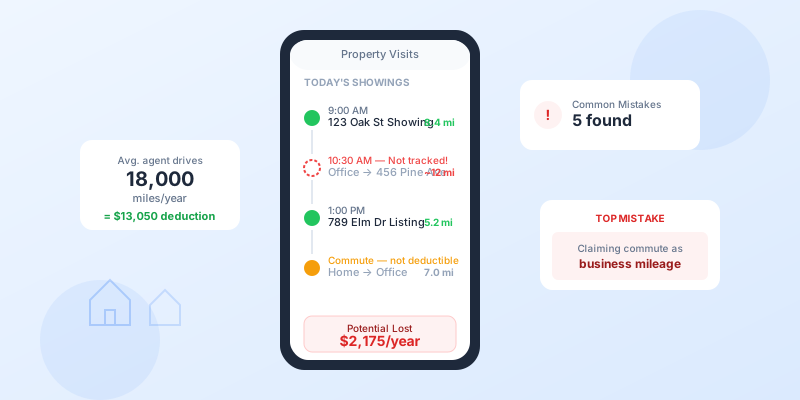
Then your CPA calls and asks about all the other driving you do for work. The staging consultations. The broker opens. The lockbox runs. The networking events. The coffee meetings with potential buyers.
“Wait,” you say. “Those count too?”
They do. And if you’re not tracking them, you’re leaving thousands on the table.
The Trips Most Agents Forget
Here’s what a typical real estate agent tracks:
- Showings with clients
- Client meetings at their office
Here’s what they should be tracking:
Broker and agent opens — You’re previewing listings, even if they’re not yours. That’s market research. That’s business miles.
Sign installation and removal — Every time you drive to put up or take down a sign, that’s deductible.
Staging consultations — Meeting with a stager, picking up staging materials, or doing a walkthrough to plan staging? All business miles.
Networking events — Chamber of commerce breakfasts, real estate association meetings, lead group lunches. If it’s about building your business, it counts.
Home office to first appointment — If your home office is your principal place of business (and for most agents, it is), your commute to your first showing becomes deductible. Same for the drive home from your last appointment of the day.
Open houses for other agents’ listings — Sitting an open house for a colleague? That’s prospecting. That’s a business trip.
Driving to properties you don’t end up listing — You drove out to meet a potential seller. They decided not to list. You still deduct those miles.
Supply runs — Office supply stores, print shops for flyers, hardware stores for lockboxes. All deductible.
The Home Office Game Changer
Most agents operate from a home office. That designation changes everything about your mileage deductions.
If your home office is your principal place of business—meaning it’s where you do your administrative work, manage your business, and meet with clients (even via Zoom)—then IRS rules treat it as your office location.
That means:
- Your first trip of the day from home to a work location is deductible
- Your last trip of the day back home is deductible
- You’re not commuting—you’re traveling between work locations
Without a home office, that first and last trip is a commute, which isn’t deductible. With a home office, it’s business travel.
For an agent driving 30 miles to their first showing and 30 miles back home, that’s 60 miles per day. At 72.5 cents per mile (the 2026 IRS rate), that’s $43.50 per day. Work 200 days a year, and that’s $8,700 in additional deductions you can claim—just from those first and last trips. Read our full guide on first and last trip commute rules to make sure you qualify.
Real Numbers: What This Actually Costs You
Say you’re a top producer closing 35 homes a year, making around $280,000 in commission income.
You track your showings religiously. Every client meeting, every property tour. You log about 5,000 miles for the year and claim a $3,625 deduction (at 72.5 cents per mile).
Then your CPA asks you to reconstruct all your business driving for just one month.
You find:
- 12 broker opens you hadn’t logged
- 8 trips to place or remove signs
- 4 networking events
- 3 staging consultations
- 6 trips to print flyers or buy supplies
- About 40 “first trip of the day” miles you didn’t realize were deductible
That one month? You’d logged 417 miles. You should have logged 1,214 miles.
You’d been missing nearly two-thirds of your deductible mileage.
Extrapolated to a full year, you should have been claiming around 14,000 miles, not 5,000. That’s a $6,525 deduction left on the table. At a typical tax rate, that’s about $2,600 in real money.
Start tracking everything. Your deduction could nearly triple.
Team Structures: Who Deducts What
If you work on a team, mileage deductions get more complicated.
Solo agents: You deduct everything related to your business.
Team leaders: You deduct miles related to managing your team, training, recruiting, and your own production.
Team members on a split: If you’re a buyer’s agent working under a team leader, you still track and deduct your own miles. Your 1099 reflects your income, so you get to deduct your expenses.
Assistants and transaction coordinators: If you’re a W-2 employee, you can’t deduct unreimbursed mileage anymore (that changed in 2018). But you should be getting reimbursed by your team leader or brokerage. If you’re driving for work and not getting reimbursed, that’s a conversation to have with your boss—or a labor issue, depending on your state.
What About Driving to Listings You Don’t Sell?
Yes, those count.
You drove 45 minutes to meet a seller who was thinking about listing. They decided to wait six months. That’s still a business expense. You drove in pursuit of income. The fact that it didn’t work out doesn’t change that.
Same goes for:
- Expired listing appointments that didn’t convert
- For Sale By Owner consultations where they didn’t hire you
- Competitive market analyses you delivered that didn’t turn into listings
If it’s a legitimate business purpose, it’s deductible. Results don’t matter.
How to Actually Track All This
The problem isn’t that agents don’t know these trips are deductible. The problem is remembering to log them.
You finish an open house, hop in the car, and drive to the grocery store. You forget to stop the trip or mark where the business part ended. You’re rushing between appointments and don’t think to pull out your phone and manually log each one.
This is why automatic mileage tracking apps exist.
Turn it on once. It detects when you start driving. You classify the trip as business or personal later. At tax time, you export a report with every business trip, GPS-verified, timestamped, and categorized.
No memory required. No end-of-year scramble. Just open the app once a week, swipe a few trips as “business,” and move on.
The Bottom Line
If you’re a full-time agent and you’re claiming less than 10,000 business miles per year, you’re probably missing deductions.
Run the numbers for yourself:
- How many showings do you do per week?
- How many open houses?
- How many broker opens?
- How many networking events, supply runs, or coffee meetings?
- Are you counting your first and last trip of the day?
Go back through your calendar for one month. Estimate the mileage for every work-related trip. Multiply by 12. Compare that to what you claimed last year.
If there’s a big gap, you know what to do.
Start tracking everything. Not just the obvious stuff.
Because at 72.5 cents per mile, the trips you’re forgetting are costing you thousands. Use our mileage deduction calculator to see what you’re leaving on the table. And if you’re not sure whether to use the standard mileage rate or actual expenses, run both calculations before you file.