
Picture this: it’s April, and you’re sitting with your accountant reviewing your tax return.
“You claimed the standard mileage rate,” your accountant says. “But you had $8,000 in car repairs last year. We might’ve saved you money with actual expenses.”
Your stomach drops. “How much money?”
“About $1,200. But here’s the thing—you used standard mileage in your first year with this car. You can’t switch to actual expenses now. You’re locked in.”
This is an expensive lesson a lot of people learn too late: the choice between standard mileage and actual expenses isn’t just about this year’s taxes. It’s a decision with long-term consequences, and most people make it without understanding the math.
Here’s how to choose the right method for your situation—before you get locked into the wrong one.
The Two Methods: What You’re Actually Choosing
When you deduct vehicle expenses for business, you pick one of two paths:
Standard Mileage Rate
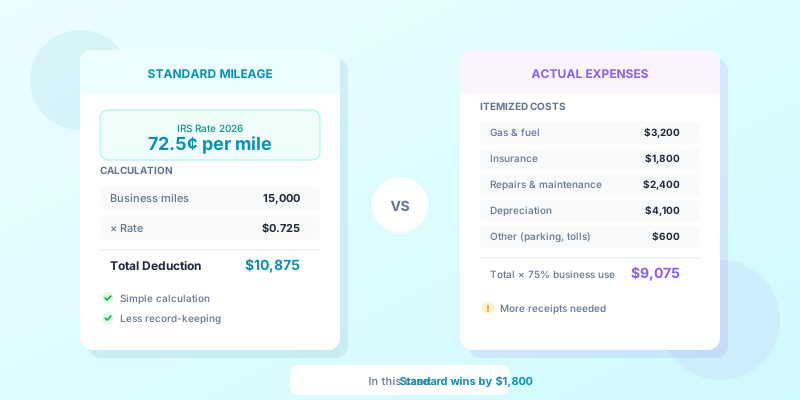
Multiply your business miles by the IRS rate (72.5 cents per mile in 2026). Simple math. One number. Done.
Example: 15,000 business miles × $0.725 = $10,875 deduction
Actual Expense Method
Track every dollar you spend on your car, calculate the percentage used for business, then deduct that percentage of your total costs.
Example: $18,000 total car expenses × 60% business use = $10,800 deduction
Same car, similar result. But the requirements and long-term implications are completely different.
The Simple Comparison Table
Here’s what’s included in each method:
| Expense Type | Standard Mileage | Actual Expense |
|---|---|---|
| Gas | ✓ (included in rate) | ✓ (track receipts) |
| Oil changes | ✓ (included in rate) | ✓ (track receipts) |
| Repairs | ✓ (included in rate) | ✓ (track receipts) |
| Tires | ✓ (included in rate) | ✓ (track receipts) |
| Insurance | ✓ (included in rate) | ✓ (track receipts) |
| Registration | ✓ (included in rate) | ✓ (track receipts) |
| Car washes | ✓ (included in rate) | ✓ (track receipts) |
| Depreciation | ✓ (built into rate) | ✓ (calculate separately) |
| Lease payments | ✓ (built into rate) | ✓ (deduct business %) |
| Loan interest | ✗ (not deductible) | ✓ (deduct business %) |
| Parking fees | ✓ (add on top) | ✓ (add on top) |
| Tolls | ✓ (add on top) | ✓ (add on top) |
Key insight: With standard mileage, parking and tolls are the only things you track separately. Everything else is built into the 72.5-cent rate.
When Standard Mileage Wins (Most Cases)
Standard mileage is the better choice for most people because:
1. You drive a lot of miles
The more you drive, the more the standard rate adds up—even if your actual costs are low.
Example: Rideshare driver with a paid-off Honda Civic
- Business miles: 30,000 per year
- Standard mileage deduction: 30,000 × $0.725 = $21,750
- Actual car expenses: $6,000 (gas, maintenance, insurance)
- Business use: 90%
- Actual expense deduction: $6,000 × 90% = $5,400
Standard mileage wins by $16,350. This is the common scenario for gig workers with older, reliable vehicles.
2. You drive a reliable, fuel-efficient car
If your car doesn’t break down often and gets decent gas mileage, your actual expenses are low. The standard rate assumes average costs, so you come out ahead.
3. You don’t want to track receipts
With standard mileage, you only track one thing: miles. No filing gas station receipts. No logging oil changes. No calculating depreciation.
For most people, the time saved is worth more than any potential tax savings from actual expenses.
4. Your business use percentage is high
If you use the car 90% for business, standard mileage gives you 90% of the maximum benefit with 10% of the paperwork.
When Actual Expenses Win
There are specific scenarios where actual expenses deliver a bigger deduction:
1. You drive an expensive or luxury vehicle
High-end cars have higher depreciation, insurance, and loan interest. The standard rate doesn’t capture those costs.
Example: Real estate agent with a leased BMW X5
- Business miles: 12,000 per year
- Standard mileage deduction: 12,000 × $0.725 = $8,700
Actual expenses:
- Lease payments: $9,600
- Insurance: $2,400
- Gas: $3,000
- Maintenance: $1,200
- Total: $16,200
- Business use: 60%
- Actual expense deduction: $16,200 × 60% = $9,720
Actual expenses win by $1,020.
2. You had major repairs this year
Engine replacement. Transmission rebuild. New set of tires and brakes. These big-ticket items push actual expenses higher.
Example: Delivery driver with an older van
- Business miles: 18,000 per year
- Standard mileage deduction: 18,000 × $0.725 = $13,050
Actual expenses:
- Transmission replacement: $4,500
- Tires and brakes: $1,800
- Gas: $4,200
- Insurance: $1,800
- Maintenance: $1,200
- Total: $13,500
- Business use: 85%
- Actual expense deduction: $13,500 × 85% = $11,475
Standard mileage wins by $1,575. If this driver had another major repair, actual expenses could’ve been better.
3. You finance the vehicle and have high interest payments
Standard mileage doesn’t let you deduct loan interest. Actual expenses do.
Example: Sales rep with financed truck
- Business miles: 15,000 per year
- Standard mileage deduction: 15,000 × $0.725 = $10,875
Actual expenses:
- Loan payments (principal + interest): $7,200
- Interest portion of payments: $2,400
- Insurance: $1,800
- Gas: $3,600
- Maintenance: $1,000
- Total deductible: $8,800
- Business use: 70%
- Actual expense deduction: $8,800 × 70% = $6,160
Standard mileage still wins here. But if business use was higher (90%) or the loan interest was steeper, the math could flip.
4. You drive fewer miles but have high fixed costs
Low-mileage drivers with expensive insurance, registration, or lease payments might do better with actual expenses.
The “First Year” Rule That Locks You In
Here’s the part that trips people up: the method you choose in the first year you use a car for business determines what you can do in future years.
If You Start With Standard Mileage:
You can switch to actual expenses in later years. But once you switch, you can’t go back to standard mileage for that vehicle. Ever.
Example:
- Year 1 (2025): Use standard mileage ✓
- Year 2 (2026): Switch to actual expenses ✓
- Year 3 (2027): Want to go back to standard mileage ✗ (not allowed)
If You Start With Actual Expenses:
You’re locked into actual expenses for the life of the vehicle. You can never use standard mileage for that car.
Exception: If you depreciate the vehicle using straight-line depreciation (not accelerated methods), you might be able to switch to standard mileage later. But this requires careful tax planning from year one.
Why This Matters:
Let’s say you buy a new car and have a major repair in year one. You use actual expenses to capture that big deduction. Smart, right?
Not necessarily. In years 2-10, when the car runs fine, you’re stuck tracking every receipt for minimal benefit. You can’t switch to the simpler standard mileage method.
The safest play: Start with standard mileage in year one. It keeps your options open.
Switching Methods: The Rules
Here’s exactly when you can (and can’t) switch:
Standard → Actual Expenses
Allowed: Yes, in any year after the first year you used standard mileage.
Catch: You must use straight-line depreciation going forward. You can’t use accelerated depreciation (Section 179, bonus depreciation) if you ever used standard mileage on that vehicle.
When to do it: If you have unusually high expenses in a particular year (major repair, high insurance increase), run the numbers. Switching might save money.
Actual Expenses → Standard Mileage
Allowed: Only if you used straight-line depreciation from the beginning.
Catch: If you used accelerated depreciation (Section 179, bonus depreciation, MACRS) at any point, you’re locked into actual expenses forever.
When to do it: Almost never worth it. If you started with actual expenses, you’re committed to tracking receipts. The hassle of switching back rarely pays off.
Leased Vehicles
Special rule: If you use standard mileage in the first year of a lease, you must use standard mileage for the entire lease period. No switching.
Depreciation: The Long-Term Impact
Depreciation is where the methods diverge in ways that affect your taxes for years.
Standard Mileage Depreciation
The IRS builds depreciation into the standard rate. For 2026, 35 cents of the 72.5-cent rate is depreciation.
When you use standard mileage, you’re automatically depreciating the vehicle by 35 cents per mile. You don’t calculate this—it happens in the background.
Impact: When you sell the vehicle, you may owe depreciation recapture tax on the portion you deducted.
Example:
- You drove 50,000 business miles over 5 years using standard mileage
- Depreciation embedded in those deductions: 50,000 × $0.35 = $17,500
- When you sell the car, you owe taxes on up to $17,500 of the gain (if any)
Actual Expense Depreciation
You calculate depreciation separately using one of several methods:
- Straight-line (simplest)
- MACRS (accelerated, most common)
- Section 179 (immediate expensing up to limits)
- Bonus depreciation (additional first-year write-off)
Impact: You can accelerate depreciation to get bigger deductions upfront. But it also means bigger recapture taxes when you sell.
Strategy tip: If you’re buying a vehicle and expect to have high income in the first year, actual expenses with Section 179 or bonus depreciation can deliver a massive upfront deduction.
But if your income is steady year-to-year, standard mileage smooths out deductions and is simpler to manage.
The Hybrid Approach: Best of Both Worlds?
Here’s a trick most people miss: even with standard mileage, you can deduct parking fees and tolls separately.
This is technically a hybrid approach, and it’s the sweet spot for most business drivers.
What you deduct:
- Standard mileage rate for all business miles
- Parking fees (meters, garage fees, etc.)
- Tolls (bridges, highways, etc.)
What you can’t double-dip:
- Gas (already in the standard rate)
- Oil changes (already in the rate)
- Repairs (already in the rate)
Example: Real estate agent
- Business miles: 18,000 × $0.725 = $13,050
- Parking fees (downtown showings): $480
- Bridge tolls (client meetings across the bay): $240
- Total deduction: $13,770
Simple tracking (just miles + parking/tolls), maximum benefit.
Three Real Scenarios: Which Method Wins?
Scenario 1: The Full-Time Rideshare Driver
Profile:
- 2019 Toyota Prius (paid off)
- 35,000 business miles per year
- $600/month in expenses (gas, insurance, maintenance)
Standard Mileage:
- 35,000 × $0.725 = $25,375
Actual Expenses:
- $7,200 annual costs
- 95% business use
- $7,200 × 95% = $6,840
Winner: Standard mileage by $18,535
Why: High mileage and low actual costs make standard mileage the obvious choice. This driver gets to deduct 72.5 cents per mile even though their real costs are about 20 cents per mile. (If you’re a gig driver, make sure you’re tracking all your miles—not just what DoorDash reports.)
Scenario 2: The Real Estate Agent (Leased Luxury Vehicle)
Profile:
- 2025 Mercedes GLE (leased)
- 15,000 business miles per year
- $1,200/month lease + $200/month insurance + $250/month gas
Standard Mileage:
- 15,000 × $0.725 = $10,875
Actual Expenses:
- Lease: $14,400
- Insurance: $2,400
- Gas: $3,000
- Maintenance: $800
- Total: $20,600
- 65% business use
- $20,600 × 65% = $13,390
Winner: Actual expenses by $2,515
Why: High fixed costs (lease, insurance) and luxury vehicle depreciation make actual expenses better. The low mileage means the standard rate doesn’t add up enough to compete.
Scenario 3: The Consultant (Moderate Mileage, Older Car)
Profile:
- 2018 Honda Accord (owned, loan paid off)
- 12,000 business miles per year
- $400/month in expenses (gas, insurance, maintenance)
Standard Mileage:
- 12,000 × $0.725 = $8,700
Actual Expenses:
- $4,800 annual costs
- 75% business use
- $4,800 × 75% = $3,600
Winner: Standard mileage by $5,100
Why: Even with moderate mileage, the standard rate delivers a much larger deduction than actual costs. The paid-off car means no loan interest to deduct.
How to Decide: The Quick Decision Tree
Step 1: Is this the first year you’re using this vehicle for business?
- Yes → Start with standard mileage (keeps options open)
- No → Continue to Step 2
Step 2: Do you drive more than 15,000 business miles per year?
- Yes → Standard mileage likely wins
- No → Continue to Step 3
Step 3: Do you have a leased or financed luxury vehicle?
- Yes → Run the numbers; actual expenses might win
- No → Continue to Step 4
Step 4: Did you have major repairs this year (over $3,000)?
- Yes → Calculate both methods before deciding
- No → Use standard mileage
Step 5: Do you want to track every receipt and calculate depreciation?
- No → Use standard mileage
- Yes → Calculate both methods
The Calculator: Run Your Own Numbers
Here’s how to compare both methods for your situation:
Standard Mileage Calculation:
Business miles × $0.725 = Deduction
+ Parking fees
+ Tolls
= Total standard mileage deduction
Actual Expense Calculation:
Add up all car expenses for the year:
+ Gas
+ Oil changes
+ Repairs
+ Tires
+ Insurance
+ Registration/fees
+ Car washes
+ Lease payments or loan interest
+ Depreciation (calculate separately)
= Total car expenses

Total car expenses × Business use % = Deduction
+ Parking fees
+ Tolls
= Total actual expense deduction
Compare the two totals. The higher number wins.
But also consider:
- How much time you’ll spend tracking receipts
- Whether you want to stay flexible for future years
- Whether you’re planning to sell the vehicle soon (affects depreciation recapture)
The Most Common Mistakes
1. Not choosing at all
You can’t use both methods in the same year for the same vehicle. Pick one when you file your taxes. If you don’t choose explicitly, the IRS assumes standard mileage.
2. Switching without understanding the rules
Switching from standard to actual? Fine. Switching from actual to standard? Probably not allowed unless you used straight-line depreciation from day one.
3. Double-dipping
You can’t claim actual gas expenses and then also use the standard mileage rate. Pick one.
4. Forgetting to track mileage
Even with actual expenses, you still need a mileage log to prove business use percentage. No log = no deduction.
5. Not running the numbers
Most people just pick standard mileage because it’s simpler. Sometimes that’s the right call. But if you have high expenses, at least calculate actual expenses once to see if you’re leaving money on the table.
What You Should Have Done
Back to that scenario from the beginning. Here’s what went wrong and how you could’ve avoided it.
Year 1: You buy a used truck for your construction business. You use standard mileage because your accountant says “it’s easier.”
Year 2: The truck needs $8,000 in repairs (engine work, new suspension). You’re stuck with standard mileage and can’t capture those costs.
What you should’ve done:
In Year 1, calculate both methods:
- Standard mileage: $9,800
- Actual expenses (with Section 179 depreciation): $14,200
Actual expenses would’ve been better. More importantly, by choosing actual expenses in Year 1, you could’ve continued using it in Year 2 when the major repairs hit.
The lesson: In your first year, calculate both methods even if you ultimately choose standard mileage. Know what you’re giving up.
Start Tracking for Next Year
Whichever method you choose, it all starts with accurate mileage tracking.
Standard mileage requires it. Actual expenses require it (to calculate business use percentage). There’s no way around it.
Set up automatic mileage tracking now:
- Download a mileage tracking app
- Grant location permissions
- Let it run in the background
- Review trips weekly to classify as business or personal
At tax time, you’ll have clean records and can make an informed choice about which method saves you the most money.
And if you’re trying to decide between methods, use our mileage deduction calculator to run both calculations. The answer might surprise you—and could save you thousands.
Do the math before you file.