
Say you’re a freelance graphic designer. You work from home most days, but twice a week you drive to client meetings. You figure all that driving is deductible.
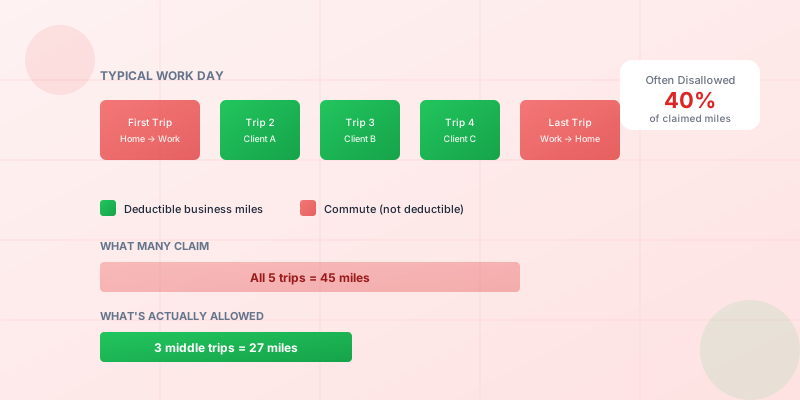
Then you get audited. The IRS disallows about 40% of your mileage claim—every first trip of the day and every drive home.
Your mistake: You didn’t have a qualifying home office.
The rules around first and last trips of the day are some of the most misunderstood in mileage deductions. Here’s what you need to know.
The Basic Rule: Commutes Aren’t Deductible
The IRS has a straightforward principle: Commuting from your home to your regular work location is a personal expense.
It doesn’t matter how far you drive. It doesn’t matter that you need a car to earn your income. The drive from home to work and from work to home is considered a personal commute.
This rule has existed for decades and applies to employees and self-employed people alike.
Why? The IRS views your choice of where to live as a personal decision. Living 30 miles from your workplace is your choice, not a business necessity.
What Counts as a “Regular Work Location”?
Here’s where it gets complicated.
If you’re a W-2 employee: Your office is your regular work location. Driving there = commute.
If you’re self-employed: Your regular work location depends on where you actually work. If you rent an office, that’s your regular work location. If you work from home, your home might be your regular work location (more on this below).
If you have multiple work locations: The IRS says your “regular” location is where you spend the most time or earn the most income. Travel between work locations is usually deductible, but getting to your first location is still a commute.
Why This Matters for Gig Workers
Here’s a scenario that catches many gig workers off guard.
You’re a DoorDash driver. You live in the suburbs. You drive 10 miles to the restaurant district where orders are plentiful. Then you dash for 6 hours, drive home, and call it a day.
Many drivers think all those miles are deductible. But under strict IRS rules:
- Drive to the restaurant district: Might be a commute (not deductible)
- Miles while dashing: Deductible
- Drive home: Might be a commute (not deductible)
Wait—how can a gig worker have a “commute”? They don’t have an office.
The IRS would argue that the restaurant district is your regular work location because that’s where you regularly perform your work. Getting there and back is commuting.
The good news: Most gig workers can establish a home office that changes this calculation. More on that shortly.
The Home Office Exception: When Everything Changes
Here’s the rule that saves most self-employed people:
If your home is your principal place of business, then travel from your home to any other work location is business travel—not commuting.
This single exception transforms your first and last trips from nondeductible commutes to deductible business miles.
To qualify, your home must be:
- Used regularly and exclusively for business — A dedicated space (room, corner, etc.) used only for work
- Your principal place of business — Either where you conduct substantial administrative/management activities, OR the only fixed location where you conduct those activities
For many self-employed people, this is easy to meet:
- Freelancers who take calls, do paperwork, and manage their business from home
- Gig workers who track earnings, plan routes, and handle admin from home
- Real estate agents who work from a home office between showings
- Sales reps who manage accounts and do paperwork at home
If your home is your principal place of business:
- Your first trip to a client, job site, or work area = business miles (deductible)
- Your last trip home = business miles (deductible)
- Everything in between = still business miles (deductible)
This can add thousands of dollars to your deduction.
The Math: What You’re Missing Without a Home Office
Let’s run the numbers.
Scenario: You’re a real estate agent. You drive from home to 3 showings, then home. Each showing is 15 miles apart.
Without home office qualification:
- Home to showing #1 (15 miles): Commute, not deductible
- Showing #1 to #2 (15 miles): Deductible
- Showing #2 to #3 (15 miles): Deductible
- Showing #3 to home (15 miles): Commute, not deductible
Deductible miles: 30
With home office qualification:
- Home to showing #1 (15 miles): Deductible
- Showing #1 to #2 (15 miles): Deductible
- Showing #2 to #3 (15 miles): Deductible
- Showing #3 to home (15 miles): Deductible
Deductible miles: 60
That’s double the deduction, just by qualifying your home office.
At the 2026 IRS mileage rate of 72.5 cents per mile, that’s an extra $21.75 per day. Work 200 days, and you’re looking at $4,350 in additional deductions.
The Temporary Work Location Exception
Even without a home office, there’s another way your first trip might be deductible.
Temporary work location rule: If you travel to a work location that’s expected to last less than one year, that travel is deductible even if it’s your first trip of the day.
Examples:
- A consultant assigned to a client site for a 3-month project
- A construction worker sent to different job sites that each last a few weeks
- A trainer traveling to different corporate offices for one-day sessions
The location must be expected to be temporary at the time you start. If it’s supposed to be 6 months but gets extended to 18 months, it might retroactively become a regular work location.
This exception helps employees and contractors who don’t have home offices but do have genuinely temporary assignments.
Multiple Jobs, Multiple Rules
What if you have more than one job?
Two employers, two work locations: Your commute to your first job is nondeductible. But driving from job #1 to job #2 is deductible (you’re traveling between work locations). The drive home from job #2 is a commute—nondeductible.
Day job plus side gig: You work a 9-5 office job, then drive for DoorDash in the evenings. Your morning commute to the office = nondeductible. From the office to your dashing area = could be deductible (traveling between work locations). If you go home first after your day job, then leave for DoorDash, you’re resetting—the DoorDash trip becomes a new commute unless you have a home office.
The rules get complicated fast. The simplest solution: Establish a qualifying home office for your self-employment income. Then all your gig-related travel is deductible from the first mile.
How Rideshare and Delivery Drivers Should Think About This
If you’re a full-time or regular gig worker, the home office exception is your friend.
Most rideshare and delivery drivers do administrative work at home:
- Tracking earnings and expenses
- Managing their schedule
- Monitoring app promotions and incentives
- Filing taxes and keeping records
If you dedicate a space in your home (even a corner with a desk) to this work and use it regularly, you likely qualify for the home office deduction.
Once your home is your principal place of business:
- Leaving home to start your shift = business miles
- All miles during your shift = business miles
- Returning home after your shift = business miles
Without the home office:
- Leaving home to start your shift = commute (not deductible)
- Miles during your shift = business miles
- Returning home = commute (not deductible)
For a driver doing 50 miles per day, the home office designation might add 20+ miles to their daily deduction (the first and last 10 miles).
How to Document Your Home Office
To claim the home office exception, you need to be able to prove two things:
1. Regular and exclusive use
- You have a dedicated space used only for business
- A separate room is ideal, but a dedicated area within a room counts
- You use it regularly (not just occasionally)
2. Principal place of business
- You conduct substantial administrative or management activities there
- OR it’s the only fixed location where you conduct those activities
Documentation to keep:
- Photos of your home office space
- A floor plan showing the dedicated area
- Records of business activities conducted there (calls logged, admin work done)
- If audited, you’ll describe how you use the space and when
You don’t need to file anything special with the IRS to establish a home office. But you should be able to demonstrate it if asked.
The Freelancer’s Mistake
Back to that freelance graphic designer scenario.
The problem: You have a desk at home where you work. But you also have a shared coworking space you use twice a week. You alternate—some days at home, some days at the coworking space.
When you drive to client meetings, you claim every trip as business miles, including the first trip of the day.
The IRS argues that your coworking space is your regular work location because you have a consistent, recurring presence there. That makes your client meeting trips into commutes—starting from wherever you were that morning.
You could have avoided this by:
- Claiming your home as your principal place of business (if you do more work there than the coworking space)
- Treating the coworking space as a secondary location, not a regular one
- Documenting that your home is where you conduct most admin/management work
Without that, you end up owing back taxes plus penalties on the disallowed mileage.
The Simple Rule to Remember
Here’s the mental model:
Without a qualifying home office:
- Home → First work location = Commute (not deductible)
- Work location → Work location = Business (deductible)
- Last work location → Home = Commute (not deductible)
With a qualifying home office:
- Home → First work location = Business (deductible)
- Work location → Work location = Business (deductible)
- Last work location → Home = Business (deductible)
If you’re self-employed and regularly work from home, establishing that home office designation is one of the most valuable things you can do for your mileage deduction.
What You Should Do
1. Assess your situation. Do you have a space at home you use regularly and exclusively for business? Could your home qualify as your principal place of business?
2. Set up a proper home office. If you don’t have one, create a dedicated workspace. Document it. Start using it for your business admin work.
3. Track your first and last trips. If you have a home office, your first and last trips are deductible. Track them like any other business trip—date, destination, purpose, miles.
4. Know the exceptions. Temporary work locations. Travel between multiple jobs. These might make some trips deductible even without a home office.
5. Keep records. If audited, you’ll need to prove your home office qualifies. Photos, floor plans, and a log of how you use the space will support your case.
The Bottom Line
The drive from home to your first work destination—and the drive home at the end of the day—usually aren’t deductible. The IRS considers them commuting.
But if your home is your principal place of business, those trips become business travel.
For many self-employed people and gig workers, this one distinction can add thousands of dollars to their annual mileage deduction.
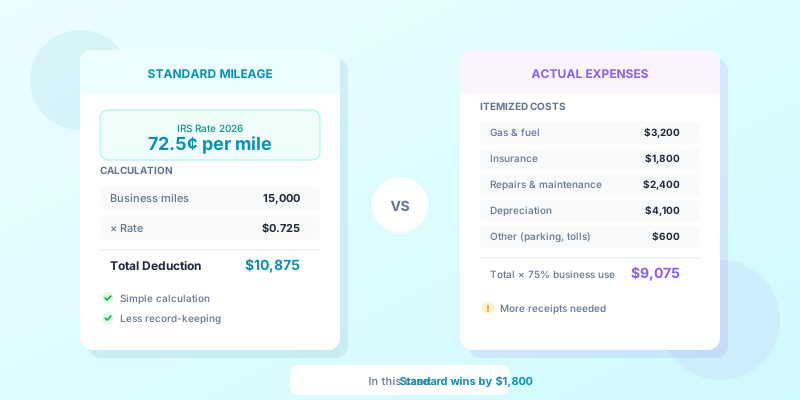
Make sure your home office qualifies. Track those first and last trips with an automatic mileage tracking app. And if you’re not sure whether to use the standard mileage rate or actual expenses method, run both calculations—our mileage deduction calculator can help.
Don’t leave money on the table just because you didn’t know the rules.