
Home healthcare workers drive more than almost any other profession. Visiting nurses, physical therapists, home health aides, and caregivers spend hours every day traveling between patients.
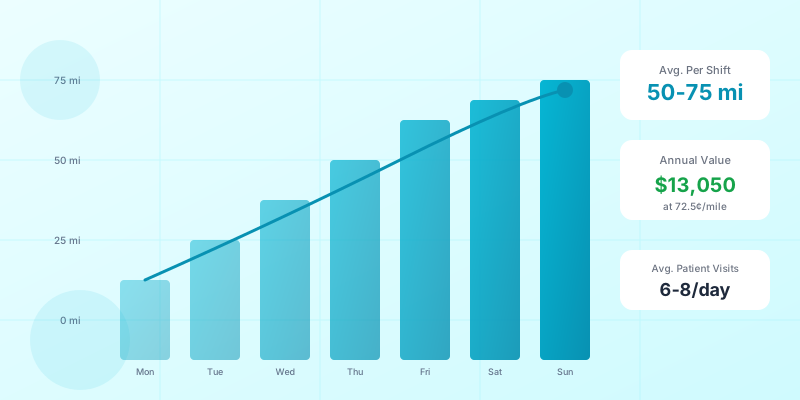
The average home healthcare worker drives 50-75 miles per shift. That’s 12,000-18,000 miles per year of work-related driving.
At the 2026 IRS mileage rate of 72.5 cents per mile, that’s $8,700 to $13,050 in annual expenses—either reimbursed by the agency or claimed as a tax deduction.
Most agencies handle this poorly. Workers don’t know what they’re owed. Agencies don’t know what they’re required to pay. And everyone loses money unnecessarily.
Here’s the guide your agency should have given you on day one.
Why Mileage Reimbursement Is a Retention Issue
Home healthcare is in a labor crisis. Turnover rates exceed 60% annually at many agencies. Workers leave for better-paying positions or burn out from the demands of the job.
Mileage costs are a huge factor.
A worker driving 15,000 miles a year for work is spending roughly $10,000 on their employer’s behalf—gas, wear and tear, maintenance, depreciation. If the agency isn’t reimbursing that, the worker is effectively taking a $10,000 pay cut.
Agencies that implement fair, transparent mileage reimbursement see measurable improvements in retention. Workers feel valued. They’re not subsidizing the agency’s operations with their own vehicle.
If you’re an agency owner reading this: Your reimbursement policy isn’t just a compliance issue. It’s a recruiting advantage.
State Requirements: Who Must Reimburse What
Mileage reimbursement requirements vary dramatically by state.
States requiring mileage reimbursement for all employees:
- California
- Illinois
- Massachusetts
- Montana
- New Hampshire
- North Dakota
- South Dakota
In these states, employers must reimburse employees for necessary business expenses, including mileage. Not reimbursing is a labor law violation.
States with partial requirements:
- Iowa and Minnesota require reimbursement only if the employer’s written policy promises it
- New York requires reimbursement if it brings workers below minimum wage
States with no general requirement:
- Most other states don’t mandate mileage reimbursement for W-2 employees
However, even in states without requirements, many agencies reimburse because it’s the only way to attract and retain workers.
If you’re a home healthcare worker in California, Illinois, or Massachusetts and your agency isn’t reimbursing mileage, you have a legal claim. Contact your state labor board.
W-2 vs. 1099: Different Rules for Different Workers
Home healthcare workers are classified as either W-2 employees or 1099 independent contractors. The mileage rules are completely different.
W-2 Employees:
- Cannot deduct unreimbursed mileage on their taxes (this changed in 2018)
- Should receive mileage reimbursement from employer
- In mandatory states, must be reimbursed by law
- If not reimbursed, the miles are essentially unreimbursed expenses
1099 Independent Contractors:
- Can deduct all business mileage on Schedule C
- The IRS rate (72.5 cents/mile in 2026) applies
- No employer reimbursement required, but deduction makes up for it
- Must track all miles to claim the deduction
The distinction matters. If you’re a W-2 employee not getting reimbursed, you’re absorbing 100% of the cost. If you’re a 1099 contractor not tracking miles, you’re missing deductions worth thousands.
The misclassification problem:
Some agencies classify workers as 1099 to avoid paying benefits and reimbursements. If you’re told when to work, required to wear a uniform, and can’t choose your own patients, you might actually be a misclassified W-2 employee.
Misclassification is illegal. If you suspect it, consult an employment attorney or file a complaint with your state labor board.
Which Miles Are Deductible or Reimbursable?
Not all work-related driving qualifies. Here’s the breakdown:
Always deductible/reimbursable:
- Driving between patients (patient A to patient B)
- Driving from agency office to first patient
- Driving from last patient back to agency office
- Trips to pick up medical supplies for patients
- Driving to required training sessions
- Travel to agency meetings
The commute question:
If you report to an agency office first and then drive to patients, that initial drive to the office is a commute—not deductible, not required to be reimbursed.
But if you go directly from home to your first patient, the rules change.
For W-2 employees, the drive from home to first patient is still technically a commute unless your home is your principal place of business.
For 1099 contractors who run their own business from home, the drive from home to first patient can be deductible. See our guide on first and last trip commute rules for the full breakdown.
The home office exception:
If your home qualifies as your principal place of business (you do administrative work there, store supplies, etc.), then your first trip to a patient becomes deductible/reimbursable. This applies to both W-2 (for reimbursement purposes) and 1099 workers.
EVV Compliance and Mileage Tracking
If your agency bills Medicaid or Medicare for home healthcare services, you’re already dealing with Electronic Visit Verification (EVV).
EVV requires agencies to electronically verify:
- When a service begins and ends
- Where it’s provided
- Who provided it
- Who received it
- What service was provided
The good news: EVV systems already capture location data. Many agencies use this same system to track mileage between visits.
If your agency uses EVV, ask if mileage tracking is integrated. Many EVV platforms offer it as an add-on feature. This eliminates duplicate tracking and ensures mileage records match visit records.
If mileage isn’t integrated, you’ll need a separate tracking system. But your EVV records can serve as backup documentation proving you were at specific patient locations at specific times.
Medicaid/Medicare Billing and Mileage Documentation
For agencies billing government programs, mileage documentation has compliance implications beyond taxes.
Some state Medicaid programs reimburse mileage separately for certain home healthcare services. To bill for it:
- Mileage must be logged with date, origin, destination, and miles
- Records must match patient visit records
- Documentation must be available for audits
Agencies: Your mileage tracking system needs to integrate with your billing records. If your caregivers are logging visits in one system and mileage in another, discrepancies will create audit problems.
Workers: Keep your own mileage records even if the agency tracks it. If there’s ever a dispute about what you drove, you’ll want your own documentation.
Setting Up Agency-Wide Tracking That Works
Most agency mileage tracking fails for one reason: It relies on workers remembering to log trips manually.
Workers are busy. They’re running between patients, dealing with medical emergencies, managing documentation. Stopping to manually enter mileage after every trip isn’t realistic.
What works:
Automatic mileage tracking apps. Every caregiver installs the app on their phone. It detects driving automatically and logs trips. At the end of the day or week, they classify trips as work or personal.
EVV integration. If your EVV system supports mileage tracking, use it. One system for visits and miles means one less thing for workers to manage.
Standard routes with exceptions. Some agencies pre-calculate mileage for common routes (office to patient A, patient A to patient B). Workers just log the route they took, plus any deviations.
What doesn’t work:
Paper logs. They get lost, they’re inconsistent, they can’t be audited against visit records.
End-of-week estimates. Workers forget what they drove on Tuesday. Estimates are inaccurate and don’t survive audits.
Trusting odometer readings alone. Without route data, there’s no way to verify the miles were actually for work.
Fair Reimbursement Rates
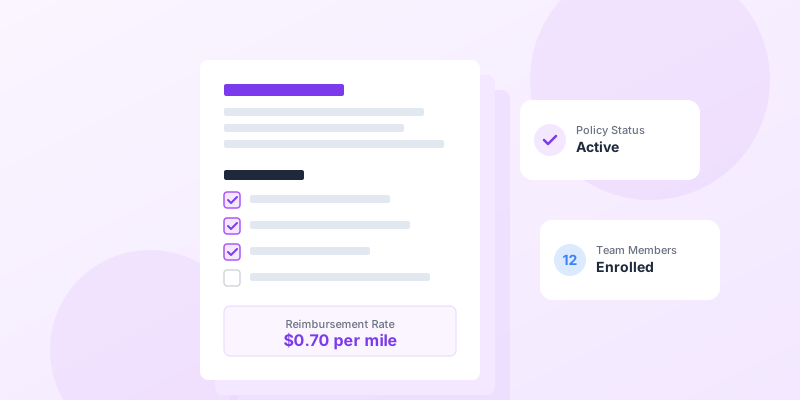
The IRS standard mileage rate for 2026 is 72.5 cents per mile. Most agencies use this rate or something close to it.
However, agencies aren’t required to reimburse at the IRS rate. Some reimburse less, arguing that their local gas prices are lower or that workers’ vehicles are older.
What’s fair:
Reimbursing at or near the IRS rate is the standard. The IRS rate accounts for gas, maintenance, insurance, depreciation, and other costs. It’s a reasonable approximation of actual vehicle costs.
Reimbursing significantly below the IRS rate (say, 40 cents/mile) puts the burden on workers. In mandatory states, this might not meet the “reasonable reimbursement” requirement.
Some agencies offer:
- Fixed car allowance: A monthly amount regardless of miles driven. Problem: Workers who drive more subsidize workers who drive less.
- Cents-per-mile: Direct reimbursement based on miles. Most common and fairest approach.
- Hybrid: A small monthly allowance plus cents-per-mile above a threshold.
The best approach is simple cents-per-mile reimbursement at or near the IRS rate, paid promptly (not at the end of the month or quarter).
The Agency That Solved Turnover
The following is a typical scenario based on industry patterns. Details are illustrative.
Consider a home healthcare agency in a mid-sized market.
The agency has 70% annual turnover. Exit interviews consistently mention unreimbursed mileage as a factor. Workers are driving 50+ miles daily and receiving $0.35/mile reimbursement—well below their actual costs.
The agency makes three changes:
- Raise reimbursement from $0.35/mile to the IRS rate
- Implement automatic tracking so workers don’t have to manually log trips
- Pay reimbursements weekly instead of monthly
The results after one year:
- Turnover drops to 45%
- Recruiting becomes easier (candidates mention the mileage policy in interviews)
- Total mileage costs increase by ~$120,000, but turnover-related costs drop by ~$340,000
The math is clear: Fair mileage reimbursement pays for itself in retention savings.
For Home Healthcare Workers: What You Should Do
If you’re a home healthcare worker, here’s your action plan:
1. Know your classification. Are you W-2 or 1099? This determines your rights and options.
2. Check your state’s requirements. In California, Illinois, Massachusetts, and several other states, W-2 employees must be reimbursed for mileage. Know your rights.
3. Track your miles. Whether for reimbursement or tax deductions, you need accurate records. Use an automatic tracking app—don’t rely on memory or estimates.
4. Calculate what you’re owed. If you’re driving 60 miles per day, 5 days a week, that’s 15,600 miles per year. At 72.5 cents/mile, that’s $11,310 in reimbursements you should receive (if W-2) or deductions you should claim (if 1099).
5. Have the conversation. If your agency isn’t reimbursing fairly, talk to HR or management. Present the numbers. In competitive labor markets, agencies that don’t reimburse lose workers to agencies that do.
For Agencies: What You Should Do
If you run a home healthcare agency, here’s your action plan:
1. Audit your current policy. What are you reimbursing? What are you missing? Are workers tracking accurately?
2. Calculate the real cost. Add up your workforce’s total annual mileage. Multiply by your reimbursement rate. That’s your current cost. Then multiply by the IRS rate. That’s what fair reimbursement costs.
3. Factor in retention costs. What does turnover cost you in recruiting, training, and lost productivity? If improving mileage reimbursement reduces turnover by even 10%, it probably pays for itself.
4. Implement automatic tracking. Get your workers on a system that logs miles without requiring manual entries. Tie it to your visit verification if possible.
5. Pay promptly. Workers shouldn’t wait 30-60 days for reimbursements. Weekly or bi-weekly payment shows you value their time and money.
The Bottom Line
Home healthcare workers drive more than almost anyone else. The profession depends on workers using their personal vehicles to reach patients.
If you’re a worker: Track every mile. Know your rights. Get what you’re owed—either through reimbursement or tax deductions.
If you’re an agency: Fair mileage reimbursement isn’t just ethical—it’s good business. The agencies winning the talent war are the ones treating workers’ vehicle expenses as the real costs they are.
At 50-75 miles per shift, the numbers are too big to ignore. Track them. Reimburse them. Deduct them.
Don’t leave thousands of dollars unaccounted for.
For agencies setting up a formal program, start with a solid mileage reimbursement policy. And if you need a platform to manage team mileage tracking and reimbursement, see how OdoAlibi works for businesses.