
Dave is an electrician in the suburbs of Toronto. Every morning he drives 95 kilometres to whatever job site the foreman assigned him. Every evening, 95 km back. For years, he assumed it was a commute—just the cost of having a job.
Then a buddy at the union hall mentioned the temporary work location rule. Dave looked into it, talked to his accountant, and discovered that nearly every kilometre he’d been driving to job sites was deductible. He’d been leaving thousands of dollars a year on the table.
If you work construction, a trade, or any field service job where job sites rotate, you might be making the same mistake.
The Rule That Changes Everything: Temporary Work Locations
The CRA has a clear rule about commuting: driving from home to your regular work location is a personal expense, not deductible.
But here’s the part most construction workers never hear:
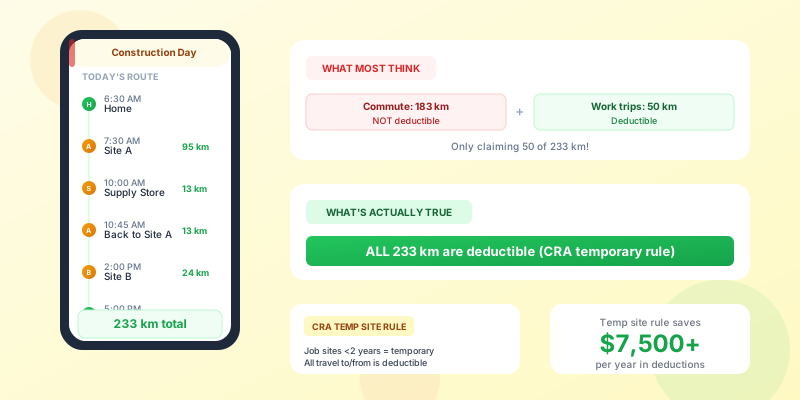
If your work location is temporary—expected to last less than a year—the drive there is deductible business travel, not commuting.
This is the temporary work location rule, and it’s the reason most construction mileage is deductible.
Think about how construction works. You’re assigned to a project. It lasts weeks or months. Then you move to the next one. You rarely work at the same site for a full year.
That means your drive to the job site isn’t a commute. It’s business travel.
How the Temporary Work Location Rule Works
The CRA draws a line at approximately one year:
- Less than one year at a location: Temporary. Travel there is deductible.
- More than one year (or expected to be): Regular. Travel there is a commute.
The key word is expected. What matters is what was reasonably expected when you started the assignment, not how long it actually lasted.
Example: You’re assigned to a condo build in Mississauga expected to take 8 months. After 7 months, it gets extended to 14 months. Because the original expectation was under a year, your travel was deductible for the first 12 months. Once it becomes clear the assignment will exceed one year, it becomes a regular work location going forward.
Example: You’re assigned to a major infrastructure project everyone knows will take 18 months from the start. That’s a regular work location from day one. Your drive there is a commute.
Most construction projects fall well under the one-year mark. If you’re moving between job sites every few weeks or months, virtually all your driving qualifies.
Multiple Job Sites in One Day
Construction workers often hit more than one site per day. Here’s how mileage works:
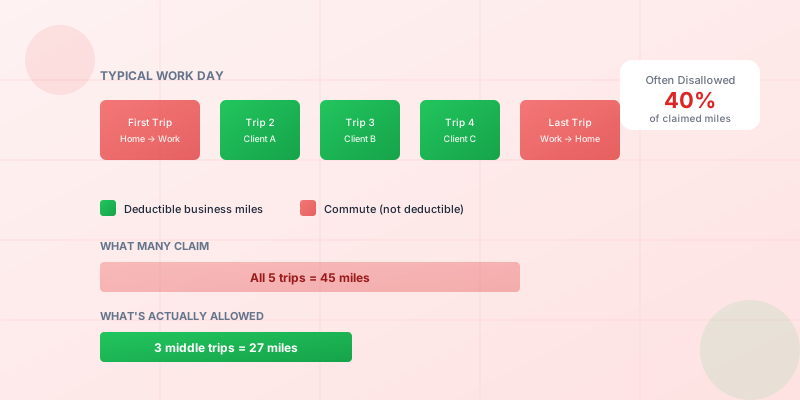
- Home to first job site: Deductible (if the site is temporary)
- Job site to job site: Deductible (travel between work locations is always deductible)
- Last job site to home: Deductible (if the site is temporary)
If you visit three sites in a day and all are temporary locations, every kilometre is deductible.
Even if your first stop is a regular location (like a main office you report to daily year-round), the drives between work locations during the day are still deductible.
Shop or Home Base to Job Site: When It Counts
Many tradespeople report to a shop, warehouse, or contractor’s yard before heading to the job site. How this affects your vehicle expenses depends on whether that shop is your regular work location.
If you report to the shop every day (year-round):
- Home to shop = Commute (not deductible)
- Shop to job site = Deductible
- Job site to shop = Deductible
- Shop to home = Commute (not deductible)
If you go directly to job sites most days:
- Home to job site = Deductible (temporary location)
- Job site to job site = Deductible
- Job site to home = Deductible (temporary location)
The difference can be huge. If the shop is 15 km from home but the job site is 95 km from home, going through the shop costs you 30 nondeductible kilometres. Going direct gives you 190 deductible kilometres.
Some workers have a choice. If you’re not required to report to the shop, going directly to the temporary job site makes all those kilometres deductible.
Tool and Material Runs During the Day
Trips during the workday for tools, materials, or supplies are business kilometres. Period.
- Running to Home Depot for parts: deductible
- Driving to the supply house to pick up an order: deductible
- Going back to the shop to grab a tool you forgot: deductible
- Picking up materials from another job site: deductible
These trips are always deductible because you’re traveling between work-related locations during the workday. The temporary location rule doesn’t even need to apply—they’re business travel by default.
Track them. They add up fast.
Union vs. Non-Union: Different Situations, Same Rules
The tax rules don’t change based on union membership, but the practical reality does.
Union workers are typically dispatched to different job sites by the union hall. This works in your favour:
- You rarely control which site you’re assigned to
- Assignments rotate regularly, reinforcing that locations are temporary
- The union hall itself isn’t usually your work location (you don’t work there)
- Your dispatch records serve as documentation of temporary assignments
Non-union workers employed by a single contractor may have a stronger argument that the contractor’s main shop is their regular work location—especially if they report there daily.
Self-employed contractors have the most flexibility. If you work from home doing estimates, bookkeeping, and scheduling, your home can be your principal place of business. That makes every trip from home to a job site deductible.
Company Vehicle vs. Personal Vehicle
This is where many construction workers check out of the mileage conversation. If the company gives you a truck, you assume vehicle expense tracking doesn’t apply to you. That’s mostly true—but not always.
Company vehicle:
- You generally can’t deduct vehicle expenses (the company owns the vehicle)
- Personal use of a company vehicle is a taxable benefit—your employer should be calculating standby charges and operating cost benefits
- If you pay for gas or maintenance out of pocket for business use, those might be deductible (talk to your accountant)
Personal vehicle with reimbursement:
- If your employer reimburses you at a reasonable per-kilometre rate (the 2026 CRA prescribed rate is 73 cents for the first 5,000 km, 67 cents after), the reimbursement isn’t taxable
- Track your kilometres anyway to make sure you’re being reimbursed for everything
Personal vehicle without reimbursement:
- If you’re a T4 employee, you may be able to deduct vehicle expenses—but you need a signed T2200 (Declaration of Conditions of Employment) from your employer confirming you’re required to use your own vehicle
- No T2200, no deduction
- If you’re self-employed, you deduct actual vehicle expenses on your T2125. Track everything.
Getting Reimbursed vs. Deducting Yourself
If you’re a T4 construction employee, your best path is reimbursement from your employer.
Why? Because claiming vehicle expenses as an employee requires a T2200, and you can only deduct the portion your employer doesn’t reimburse. Reimbursement is simpler and puts money in your pocket immediately.
Your options:
1. Ask your employer for mileage reimbursement. Many construction companies already reimburse mileage. If yours doesn’t, present the case. At 73 cents per kilometre, 30,000 annual km is $21,900—real money that costs the company less than raising your salary (reasonable reimbursements aren’t subject to payroll deductions).
2. Check your province. Some provinces have stronger employee expense protections than others. In Ontario, for example, employers are generally expected to cover expenses employees are required to incur for work. If you’re not getting reimbursed and your employer requires you to use your personal vehicle, talk to an employment lawyer.
3. If you’re self-employed, deduct it yourself. Self-employed contractors deduct actual vehicle expenses on form T2125. You track your total kilometres, your business kilometres, and your actual expenses (fuel, insurance, maintenance, lease payments, CCA). Your business-use percentage determines the deductible portion.
Important: Unlike the US, Canada does not have a standard per-kilometre deduction for self-employed individuals. You must track and claim actual expenses. Your vehicle logbook is what proves your business-use percentage.
Seasonal Work and the 12-Month Rule
Construction is seasonal across much of Canada. This creates a specific question: if you return to the same type of work (or even the same general area) every spring, does that make it a regular work location?
The CRA looks at each assignment, not the industry pattern:
- Same job site, returning seasonally: If you work at the same location every summer for years, the CRA might consider it regular—even if each stint is under 12 months. The expectation of returning matters.
- Different job sites each season: Each new site is a new temporary location. The fact that you do construction every summer doesn’t make each new site “regular.”
- Breaks between assignments: Time off between projects doesn’t reset the clock on a single project. A 3-month project that spans from November to March (with December off for weather) is still one 3-month assignment.
The safest position: If you’re going to a genuinely new job site that’s expected to last under a year, it’s temporary. If you’re returning to the same site you’ve worked at before, be more careful.
Dave’s Story: 95 Kilometres of Found Money
Back to Dave the electrician. Here’s what changed for him.
Dave works for a mid-size electrical contractor in the GTA. He’s dispatched to commercial and residential job sites across the Greater Toronto Area and beyond. Some projects last two weeks. Some last six months. He occasionally stops by the contractor’s yard in Etobicoke to load materials, but most days he drives straight from home in Oshawa to the job site.
For years, he treated every drive as a personal commute. His reasoning: “I drive to work. That’s a commute.”
After learning about the temporary work location rule, he started tracking. In his first year:
- Average daily round trip to job sites: 135 km
- Working days per year: 230
- Total deductible kilometres: ~31,050
- Total actual vehicle expenses for the year: $14,200
- Business-use percentage: 78%
- Deductible vehicle expenses: ~$11,076
Dave is a self-employed subcontractor, so he deducts on his T2125. That $11,076 deduction, at a combined federal and provincial tax rate of roughly 30%, saved him about $3,300 in taxes.
He’d been driving those kilometres for 6 years without claiming them.
The only thing that changed was knowing the rule—and starting to track.
How to Track Construction Mileage
Construction mileage tracking doesn’t need to be complicated, but it does need to happen.
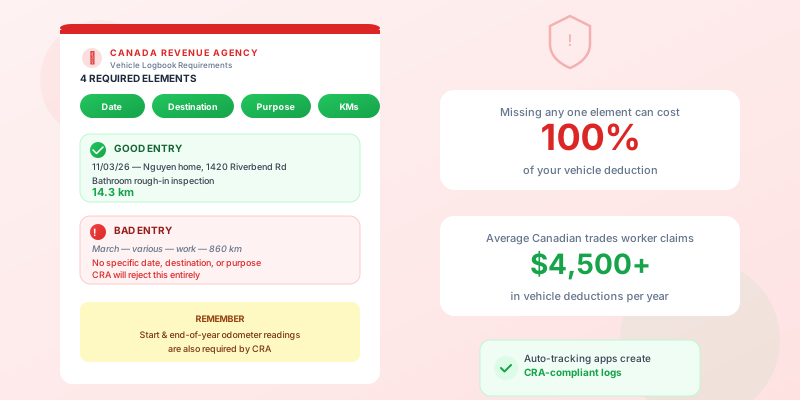
What to record for every trip:
- Date
- Starting point and destination
- Business purpose (e.g., “Dispatched to Elm Street condo build”)
- Kilometres driven
What helps during a CRA review:
- Dispatch records or assignment sheets showing which site you reported to
- Project timelines showing expected duration (under one year)
- A note in your log when you start a new job site
An automatic mileage tracking app handles most of this. You drive, it records. At the end of the day, you classify trips. At tax time, you export.
The key is consistency. The CRA wants records kept “at or near the time” of the trip—not reconstructed in April. If you’ve fallen behind, there are ways to recover past mileage, but it’s much easier to track as you go.
Don’t forget your odometer. Take a photo of your odometer on January 1 and December 31. The CRA requires start-of-year and end-of-year readings to verify your total annual kilometres and business-use percentage.
What You Should Do
1. Figure out if your job sites are temporary. If you’re assigned to sites that last less than a year (and you expected them to), your travel there is deductible.
2. Know your employment status. If you’re self-employed, you deduct actual vehicle expenses on your T2125. If you’re a T4 employee, get a T2200 from your employer or push for reimbursement.
3. Start tracking today. Even if you’ve been ignoring mileage for years, start now. Every kilometre you track going forward is a kilometre you can claim.
4. Keep your dispatch records. Assignment sheets, project schedules, and contractor communications all support the temporary work location argument.
5. Talk to an accountant. If you’re unsure whether your situation qualifies, an accountant who understands construction work can tell you quickly. The consultation fee pays for itself many times over.
The Bottom Line
Most construction workers, tradespeople, and field service workers drive to temporary job sites. Under CRA rules, that travel is deductible—it’s not a commute.
The temporary work location rule exists specifically for people like you. If your job site changes regularly and each assignment lasts less than a year, your kilometres count.
Don’t leave thousands of dollars unclaimed because you assumed your drive to work was just a commute. Track your kilometres, know the rules, and use our mileage deduction calculator to see what you could be saving.