
“I only drive to one or two client meetings a month. Is it even worth tracking?”
I hear this question constantly. Someone does a bit of freelance work. They drive to networking events occasionally. Maybe they visit a client site once a week. The miles feel… insignificant.
So they don’t bother.
Then tax season arrives, and they realize those “insignificant” trips added up to 3,000 miles. At the 2026 IRS rate of 72.5 cents per mile, that’s $2,175 they can’t deduct—because they have no records.
Here’s the thing: the threshold for “worth tracking” is a lot lower than most people think.
The Real Math: When Does Tracking Pay Off?
Let’s run the numbers for different scenarios.
The “barely driving” freelancer:
- 200 business miles per month
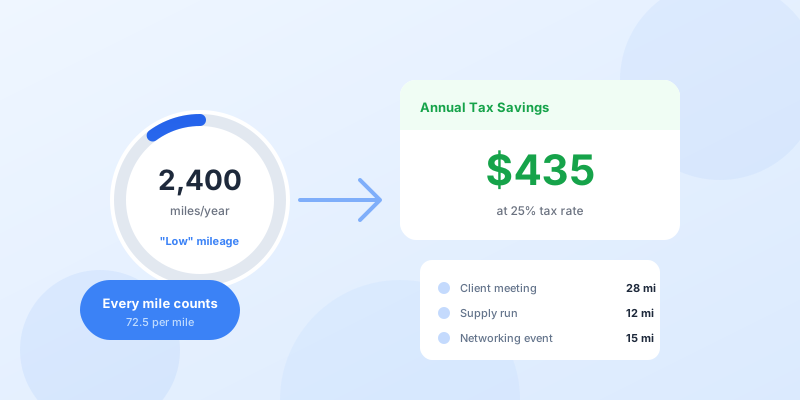
- 2,400 miles per year
- Deduction: 2,400 × $0.725 = $1,740
At a 25% marginal tax rate, that $1,740 deduction saves you $435 in federal taxes.
Is $435 worth tracking 200 miles a month?
The monthly client meeting consultant:
- 4 client visits per month, 30 miles each round trip
- Plus 2 networking events, 15 miles each
- Monthly total: 150 miles
- Annual total: 1,800 miles
- Deduction: 1,800 × $0.725 = $1,305
That’s $326 in tax savings at a 25% rate. Still real money.
The “I go to the office most days” hybrid worker with a side business:
- Side business requires 50 miles of driving per month
- Annual total: 600 miles
- Deduction: 600 × $0.725 = $435
Even at 600 miles a year—basically one tank of gas per month—you’re looking at $109 in tax savings. Not life-changing, but would you leave a hundred-dollar bill on the sidewalk?
The “Might As Well” Argument for Automatic Tracking
Here’s what changed my mind about low-mileage tracking: it takes almost no effort if you set it up right.
With an automatic mileage tracking app, you:
- Download the app
- Grant location permissions
- Forget about it
The app runs in the background. It detects when you’re driving. It logs the trip automatically. At the end of the week (or month, or year), you review trips and mark them as business or personal.
Total time investment? Maybe 5 minutes per week for someone with low mileage. That’s 4-5 hours per year to capture potentially hundreds of dollars in deductions.
Compare that to reconstructing your mileage from memory at tax time. That takes hours, produces inaccurate records, and won’t survive an audit.
The “might as well” math:
Let’s say you spend 5 minutes per week reviewing trips: 260 minutes per year (about 4.3 hours).
If you capture $400 in tax savings, you’ve “earned” $93 per hour for that time.
Even if your deduction is only $200, that’s still $46 per hour—better than most side hustles.
The effort is so minimal that the question isn’t really “is tracking worth it?” It’s “why wouldn’t I track?”
The Hidden Benefit: Audit Protection
Here’s something people overlook: mileage records protect you even if the deduction is small.
If you claim $1,500 in mileage deductions and get audited, the IRS will ask for documentation. Without records, you have two options:
- Lose the entire deduction
- Try to reconstruct from memory (which auditors hate)
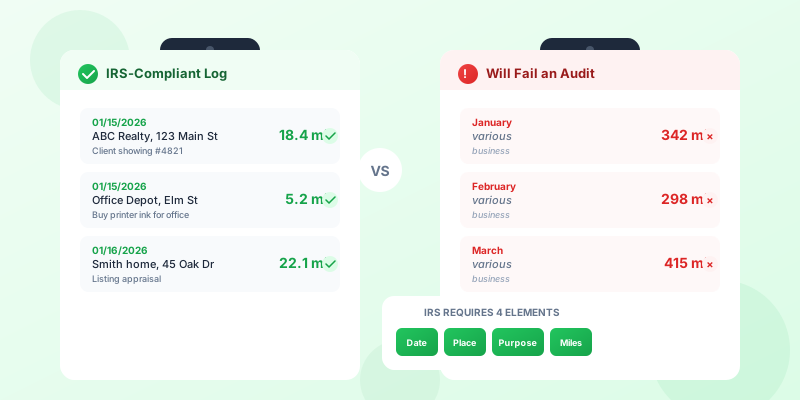
With a proper mileage log—dates, destinations, purposes, miles—you can confidently defend your deduction. The audit becomes a paperwork exercise instead of a negotiation.
What the IRS actually requires:
According to IRS Publication 463, you need “adequate records” including:
- Date of each trip
- Destination
- Business purpose
- Miles driven
A tracking app produces exactly this documentation, automatically. It’s timestamped, GPS-verified, and organized. Auditors love it because it’s hard to fabricate.
One tax professional I know put it this way: “The people who get crushed in mileage audits aren’t the ones claiming huge deductions. They’re the ones claiming reasonable amounts with zero documentation.”
Low-Mileage Scenarios That Add Up
People underestimate their business driving because they don’t think certain trips count. Here are common deductible miles that low-mileage workers often miss:
For freelancers and self-employed:
- Driving to meet clients (coffee, lunch, their office)
- Bank runs for business deposits
- Office supply store trips
- Post office for shipping products
- Networking events and industry meetups
- Professional development (workshops, conferences)
- Meeting with your accountant or attorney
For gig workers and part-timers:
- Miles between gigs (even if you only work a few hours per week)
- Driving to pick up supplies for the gig
- Returning home from your last gig (if you have a home office)
For employees with side businesses:
- All miles related to your side business are deductible (separate from your W-2 job)
- Even if you drive 15,000 miles for your employer (not deductible for most W-2 workers), the 1,500 miles for your Etsy store are fully deductible
For landlords:
- Driving to rental properties for maintenance, inspections, or tenant meetings
- Trips to buy supplies or meet contractors
- Yes, even if you only own one rental property
I worked with a landlord last year who owned a single duplex. She visited the property maybe twice a month—inspections, meeting tenants, checking on repairs. She’d never tracked those miles.
When we reconstructed her driving, it came to about 800 miles per year. At 72.5 cents, that’s $580 she’d been leaving on the table annually. Over five years of ownership? Nearly $3,000.
The Minimum Threshold: When Tracking Genuinely Isn’t Worth It
Fair question: is there a floor below which tracking genuinely isn’t worth it?
If you’re self-employed or have any 1099 income:
Track everything. The threshold is essentially zero. Even 100 business miles per year is a $72.50 deduction. The tracking is free. Just do it.
If you’re a W-2 employee in the US without a side business:
For most W-2 employees, mileage isn’t deductible on your federal return anyway (the TCJA eliminated that deduction). Your path to recovering mileage costs is through employer reimbursement, not tax deductions.
Still, tracking can help you:
- Negotiate for mileage reimbursement (showing your employer what you drive)
- Claim state deductions (8 US states still allow them: Alabama, Arkansas, California, Hawaii, Maryland, Minnesota, New York, Pennsylvania)
- Prepare for a future side business
The honest floor:
If your total business driving is under 200 miles per year (about 4 miles per week), and you have no self-employment income, and you’re not trying to get employer reimbursement… fine, maybe tracking isn’t strictly necessary.
But at 200+ miles per year with any self-employment income? The numbers justify tracking.
The Habit Argument: Start Before You Need To
Here’s the most compelling reason to track even minimal mileage: you don’t know when your driving will increase.
Businesses grow. Side hustles expand. Jobs change. The freelancer doing 2,000 miles this year might be doing 10,000 next year if they land a major client.
If you’re already tracking, you won’t miss a beat. If you’re not, you’ll spend months trying to remember where you drove before you got the habit in place.
I’ve seen this pattern repeatedly:
January: “I barely drive for work. Not worth tracking.” June: Land a big client. Start driving 300 miles per month. December: Realize you have records for July-December but nothing for January-June. Tax time: Either guess at six months of mileage (risky) or claim only half the deduction (costly).
The freelancer who installed a tracking app before they needed it? They captured every mile from day one.
The cost of waiting:
Let’s say you start a side business in March but don’t start tracking until September.
Missing 6 months of mileage at 150 miles per month = 900 miles lost. At 72.5 cents = $652 in deductions you can’t claim. At 25% tax rate = $163 in tax savings, gone.
The app was free. The setup took 10 minutes. The cost of waiting was $163.
Quick Decision Framework
Still not sure if you should track? Answer these questions:
1. Do you have any self-employment income (1099, Schedule C, freelance)?
- Yes → Track your miles. Period.
- No → Continue to question 2.
2. Do you drive more than 200 miles per year for business purposes?
- Yes → Track your miles. The deduction exceeds $145.
- No → Continue to question 3.
3. Are you trying to get mileage reimbursement from your employer?
- Yes → Track your miles. You need data to make your case.
- No → Continue to question 4.
4. Might your work driving increase in the next year?
- Yes → Start tracking now. Build the habit before you need it.
- No → You might be in the rare category where tracking truly doesn’t matter. But consider: the app is free. Setup takes 10 minutes. Why not?
The Real Question
“Should I track mileage if I barely drive for work?”
The real question is: how much money are you comfortable leaving unclaimed?
At 72.5 cents per mile, business driving adds up faster than you’d expect. A few client meetings, some supply runs, an occasional networking event—suddenly you’re looking at hundreds of dollars in unclaimed deductions.
The tracking is free. The effort is minimal. The tax savings are real.
And if it turns out your mileage truly was negligible? You’ve lost nothing but 10 minutes of setup time.
Start tracking today. Even if you “barely” drive for work. Your future self—the one filing taxes next April—will thank you.
Set up automatic mileage tracking now and capture every business mile from this point forward. The math says it’s worth it. The effort says there’s no reason not to.