
You’re an outside sales rep. You drive 400 miles a week visiting clients in your territory, all in your own car. Your employer pays your salary but doesn’t reimburse mileage.
Tax season comes. You fire up TurboTax, ready to claim those 20,000 annual business miles. At 72.5 cents per mile, that’s a $14,500 deduction.
Except… you can’t. The software won’t let you.
Welcome to the post-2018 reality for W-2 employees.
What Changed in 2018
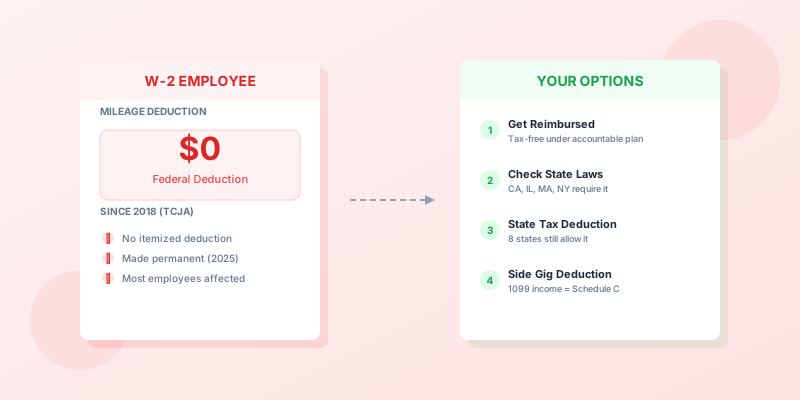
The Tax Cuts and Jobs Act (TCJA) of 2017—which took effect for the 2018 tax year—eliminated the ability for most employees to deduct unreimbursed business expenses, including mileage.
Before 2018, W-2 employees could claim unreimbursed job expenses as an itemized deduction on Schedule A. You’d add up your business mileage, work-related travel, professional dues, and other unreimbursed costs. If the total exceeded 2% of your adjusted gross income, you could deduct the excess.
It wasn’t perfect. Most people didn’t itemize, and the 2% floor ate into the deduction. But it was something.
Now? For most W-2 employees, that deduction is gone entirely. Doesn’t matter how many miles you drive. Doesn’t matter if your employer refuses to reimburse you. You cannot deduct unreimbursed mileage on your federal tax return.
The original TCJA provision was set to expire after 2025. Many employees hoped the deduction would return. But in 2025, the One Big Beautiful Bill Act (OBBBA) made the elimination permanent.
The unreimbursed employee expense deduction isn’t coming back.
Who Can Still Deduct Employee Mileage
The TCJA carved out a few narrow exceptions. According to IRS Publication 463 and the Form 2106 instructions, if you fall into one of these categories, you can still claim unreimbursed employee expenses:
Armed Forces Reservists
If you’re a reservist traveling more than 100 miles from home for reserve duties, you can deduct travel expenses including mileage. This applies to the National Guard, Army Reserve, Navy Reserve, Marine Corps Reserve, Air Force Reserve, and Coast Guard Reserve.
Qualified Performing Artists
This one has strict requirements:
- You worked for at least two employers in the performing arts
- Your adjusted gross income is $16,000 or less (before deducting performance expenses)
- Your performance-related expenses exceed 10% of your gross income from performing arts
Most professional performers don’t qualify because of the income cap.
Fee-Basis State or Local Government Officials
If you’re paid solely on a fee basis (like certain court officials, notaries, or election workers), you can deduct unreimbursed expenses related to those duties.
Employees with Impairment-Related Work Expenses
If you have a disability and incur expenses that allow you to work—like special transportation—you may be able to deduct those costs.
For everyone else with a W-2 job? No federal mileage deduction.
Your Real Option: Get Reimbursed
If you can’t deduct your mileage, your only path to recovering those costs is getting your employer to reimburse you.
Here’s the good news: employer mileage reimbursements done correctly are tax-free to you. They’re not reported as income, so you pay zero tax on them.
Here’s how to approach the conversation with your employer.
Step 1: Know your numbers
Track your business miles for at least a month before approaching your employer. Use an automatic mileage tracking app so you have solid data, not guesses.
Calculate the total: 400 miles/week × 50 weeks × 72.5 cents = $14,500 per year.
That’s real money your employer is effectively expecting you to donate to the company.
Step 2: Make the business case
Frame it from your employer’s perspective:
- Mileage reimbursement is a normal business expense (deductible for the company)
- Other employees in similar roles at other companies get reimbursed
- It affects recruitment and retention
- It’s simply fair—you shouldn’t pay out of pocket to do your job
Step 3: Know the law (in your state)
Some states require mileage reimbursement. More on that below.
Step 4: Propose a solution
Don’t just complain. Suggest a specific reimbursement rate (the IRS rate is the easy default) and a simple process for tracking and submitting. Point them to a mileage reimbursement policy template if they need help setting one up.
States That Require Mileage Reimbursement
While the federal deduction is gone, some states require employers to reimburse employees for business expenses—including mileage.
California
California Labor Code Section 2802 requires employers to “indemnify his or her employee for all necessary expenditures or losses incurred by the employee in direct consequence of the discharge of his or her duties.” If you drive your personal car for work, your employer must reimburse you. The rate must be reasonable (the IRS rate is considered reasonable). Failure to reimburse is a violation, and employees can file a wage claim or lawsuit.
Illinois
Illinois 820 ILCS 115/9.5 (part of the Illinois Wage Payment and Collection Act) requires employers to reimburse employees for “all necessary expenditures or losses incurred by the employee within the employee’s scope of employment and directly related to services performed for the employer.” Driving to client sites or between work locations for your employer’s benefit? They must reimburse you.
Massachusetts
Under 454 CMR 27.04, employees required to travel from one place to another during the work day “shall be compensated for all travel time and shall be reimbursed for all transportation expenses.” This regulation enforces Massachusetts General Law Chapter 151.
New York
New York Labor Law Section 193 prohibits employers from deducting “employer business costs” from workers’ wages. While this isn’t an explicit reimbursement mandate like California’s, it means employers cannot shift business expenses onto employees through wage deductions—providing indirect protection for workers who incur costs while driving for work.
If you’re in one of these states and your employer isn’t reimbursing mileage, it’s worth consulting your state labor department’s website or an employment attorney. The penalties for non-compliance can be significant—California employers have faced multi-million-dollar settlements, and Illinois law provides for a 2% per month interest rate on unpaid expenses with a 10-year statute of limitations.
State Income Tax Deductions
Even if you can’t deduct mileage on your federal return, some states still allow it. These states have not conformed to the federal tax changes and continue to permit itemized deductions for unreimbursed employee expenses.
States that allow unreimbursed employee expense deductions:
- Alabama
- Arkansas
- California
- Hawaii
- Maryland
- Minnesota
- New York
- Pennsylvania
Each state has its own rules, forms, and limitations. If you’re in one of these states and have significant unreimbursed business mileage, check with a tax professional about whether you can claim a state-level deduction.
The math might be worth it. If you drove 15,000 unreimbursed business miles and your state has a 5% income tax rate, a $10,875 deduction (at 72.5 cents) would save you about $544 in state taxes.
Accountable vs. Non-Accountable Reimbursement Plans
If your employer does reimburse mileage, how they do it matters for your taxes.
Accountable Plans (What You Want)
Under an accountable plan:
- You must document the business purpose, date, and miles for each trip
- You submit expense reports within a reasonable time
- You return any excess reimbursement
Result: The reimbursement is tax-free. It doesn’t appear on your W-2. You pay no income tax or payroll tax on it.
Non-Accountable Plans (What You Don’t Want)
Under a non-accountable plan:
- Documentation isn’t required, or
- You don’t have to return excess payments, or
- The reimbursement is a flat amount regardless of actual expenses
Result: The reimbursement is taxable income. It shows up on your W-2 as wages. You pay income tax and payroll tax on it.
Example:
Your employer gives you a $500/month “car allowance” with no documentation required.
That $6,000/year is fully taxable. If you’re in the 22% federal bracket plus 7.65% payroll taxes plus 5% state taxes, you’re paying about $2,080 in taxes on that allowance.
Your actual business mileage at 72.5 cents? Let’s say it’s $8,000.
So you’re receiving $6,000 (minus $2,080 in taxes = $3,920 net) to cover $8,000 in costs. You’re still out $4,080.
Compare that to an accountable plan reimbursing you $8,000 tax-free. That’s a $4,080 difference.
If your employer offers a flat car allowance instead of mileage reimbursement, you might want to have a conversation about switching to an accountable plan. It’s better for you, and it’s actually cheaper for them too (they don’t pay payroll taxes on accountable reimbursements).
Reimbursement vs. Higher Pay: What’s Better?
Let’s say your employer balks at setting up a mileage reimbursement program. They offer to give you a raise instead.
Should you take it?
The Math:
You drive 15,000 business miles per year. At 72.5 cents, that’s $10,875.
Option A: Tax-free mileage reimbursement
- You receive $10,875
- You pay $0 in taxes on it
- Net benefit: $10,875
Option B: Equivalent raise
- Your employer gives you a $10,875 raise
- You pay federal income tax (say 22%): -$2,393
- You pay payroll tax (7.65%): -$832
- You pay state tax (say 5%): -$544
- Net benefit: $7,106
The raise would need to be about $15,300 (pre-tax) to equal the $10,875 reimbursement.
Plus, your employer would pay an additional $1,170 in payroll taxes on the raise. So the raise costs them $16,470 versus $10,875 for the reimbursement.
Bottom line: A tax-free mileage reimbursement under an accountable plan is worth about 45% more than the same dollar amount added to your salary. Push for reimbursement over a raise.
What If Your Employer Won’t Budge?
You’ve made the case. You’ve shown the numbers. Your employer still refuses to reimburse your mileage.
Option 1: Check your state law
If you’re in California, Illinois, Massachusetts, New York, or certain other states, your employer may be breaking the law. You can:
- File a wage claim with your state labor board
- Consult an employment attorney
- Report the violation to your state labor department
In California especially, employers who don’t reimburse can face penalties plus interest on what they owe.
Option 2: Document everything anyway
Even if you can’t deduct mileage federally, keep detailed mileage records. You might need them to claim a state deduction (if you’re in one of the eight states that allow it), to support a reimbursement claim with your employer, or if you ever transition to self-employment or add a side gig.
Option 3: Negotiate differently
Maybe mileage reimbursement is a bridge too far, but your employer would consider:
- A company car or vehicle allowance
- Work-from-home arrangements to reduce driving
- Adjusted territory to lower your mileage
- Better base pay to offset costs
Option 4: Reconsider your employment
I don’t say this lightly. But if you’re driving 20,000 miles a year on your own dime and your employer won’t budge, that’s costing you $14,500 annually. That’s a meaningful part of your compensation.
An employer who won’t even discuss fair reimbursement for required work expenses might not be the employer you want long-term.
A Note About Side Gigs
Here’s something many W-2 employees miss: if you also have self-employment income (a side gig, freelance work, 1099 contractor work), you can deduct business mileage for that work on Schedule C.
So if you drive 15,000 miles for your W-2 job (no deduction) but also drive 5,000 miles for your Etsy business (deductible), you can claim those 5,000 miles.
Just make sure you’re keeping your employment mileage and self-employment mileage completely separate. Mixed records invite IRS scrutiny.
The Bottom Line
If you’re a W-2 employee driving your own car for work, here’s the reality:
-
You cannot deduct those miles on your federal taxes. The TCJA eliminated that deduction for most employees, and the OBBBA made it permanent.
-
A few narrow exceptions exist: military reservists, some performing artists, fee-basis government officials, and employees with impairment-related expenses.
-
Your best option is employer reimbursement. Under an accountable plan, it’s tax-free to you and tax-deductible for them. Win-win.
-
Some states require reimbursement. California, Illinois, Massachusetts, and New York have employee expense protections. Know your state’s laws.
-
Eight states allow state tax deductions. Alabama, Arkansas, California, Hawaii, Maryland, Minnesota, New York, and Pennsylvania still allow unreimbursed employee expense deductions. Check if yours is one of them.
-
Track your miles anyway. You may need them for state deductions, reimbursement claims, or if you ever start a side business or go independent.
Don’t just accept that driving for work costs you money. Push for reimbursement. Know your state’s laws. And if you have any self-employment income, make sure you’re capturing every deductible mile with automatic mileage tracking.
The law took away your deduction. It didn’t take away your options.