
You’re a consultant driving from a client meeting in Mississauga to another in downtown Toronto. On the way, you stop for gas at the Esso. Then you grab a double-double at Tim Hortons. While you’re at it, you swing by the LCBO to pick up a gift for your sister’s birthday—it’s right there in the plaza.
You get home, open your logbook. Now what?
Which of those kilometres are deductible? All of them? Some of them? Do you need to subtract the LCBO detour? What if you took the scenic route along Lakeshore because the 401 was backed up?
These gray areas trip up Canadian taxpayers constantly. The CRA gives clear rules for pure business trips. But life isn’t pure. Life has Tim Hortons runs and birthday gifts.
Here’s how to sort it out.
Filling Up on Gas During a Business Trip
Let’s start with the simplest case.
You’re driving 80 kilometres to meet a client in Hamilton. Forty kilometres in, you stop at Petro-Canada to fill up. Then you continue to your meeting.
Does the gas stop affect your deduction?
No. The entire trip remains business travel.
Stopping for fuel doesn’t convert a business trip into a personal one. It’s an incidental stop—you literally need gas to complete the business trip. The CRA isn’t expecting you to run out of fuel in the name of tax purity.
Same logic applies to:
- Using a restroom at the ONroute
- Grabbing a coffee at the drive-through
- Pulling over because of a highway closure or accident
These are minor interruptions to an otherwise business trip. Your destination hasn’t changed. Your purpose hasn’t changed. Log the full distance.
You don’t need to calculate that the Petro-Canada was 0.3 km off the highway. That’s noise, not signal.
The Coffee Stop Between Clients
Now let’s add a wrinkle.
You finish a meeting with Client A in Markham. Your next meeting with Client B is in Vaughan, 35 km away. You have an hour to kill. Instead of sitting in your car in the parking lot, you stop at a Second Cup on Highway 7, answer some emails for 20 minutes, then continue.
Is the entire distance from Client A to Client B still deductible?
Yes—as long as the coffee shop was reasonably on your route.
You’re travelling between two business locations. Taking a break along the way doesn’t change that. You’re still in transit, just with a pause.
The key word is reasonable. If the Second Cup was in the plaza on your route, no issue. If you drove 15 km into Richmond Hill for a specific latte, that’s a different story.
Personal Errands “Along the Way”
Here’s where it gets real.
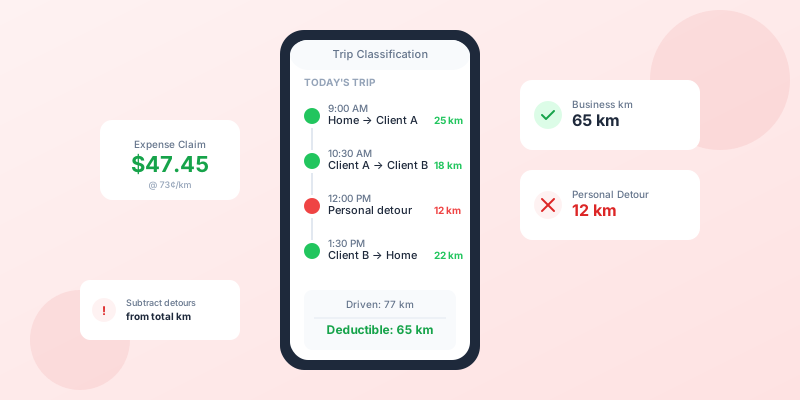
Same scenario: driving from Client A to Client B. But instead of coffee, you detour 8 km to pick up your kid from hockey practice. Then you continue to Client B.
What’s deductible now?
This is a personal errand—not an incidental stop. You have to account for it.
According to CRA guidelines on motor vehicle expenses, only the business portion of your driving is deductible.
There are two ways to handle this:
Method 1: Deduct the direct route
Calculate what the direct route would have been. Client A to Client B = 35 km. Your actual route with the hockey pickup = 51 km. The difference (16 km) is personal.
Deductible kilometres: 35
Method 2: Split the trip
Log two separate entries:
- Client A to Hockey Arena: Personal (not deductible)
- Hockey Arena to Client B: Business (deductible)
The math works out similarly. Either way, you’re not claiming the personal detour as a business expense.
Most people use Method 1 because it’s cleaner. Just figure out what the direct business route would have been and use that number.
Taking a Different Route
This one catches people off guard.
Your fastest route from your home office to a client in Oakville is 30 km on the QEW. But construction has the highway down to one lane, so you take back roads through Burlington—38 km.
Can you deduct 38 kilometres?
Practically speaking, yes. The CRA isn’t going to penalize you for avoiding gridlock.
Reasonable route choices are normal:
- Avoiding construction or accidents
- Taking a less congested route during rush hour
- Choosing roads with better winter driving conditions
- Preferring a route with easier parking at the destination
What’s not reasonable: Taking the scenic route through Niagara-on-the-Lake that adds 40 km because you felt like a drive. That’s padding your logbook.
Think of it this way: Would a reasonable businessperson take this route? If a colleague asked you why you went that way and you’d have a normal answer, you’re fine.
Combining Business and Personal in One Trip
Now let’s tackle the combo trip.
You have a client meeting downtown (business). On the same trip, you plan to meet a friend for lunch at King Street (personal) and pick up a prescription at Shoppers Drug Mart (personal). All three are in the same area. You drive downtown once, do everything, then drive home to Etobicoke.
How much is deductible?
This depends on the primary purpose of the trip.
The Primary Purpose Test
The CRA evaluates travel expenses based on the trip’s main purpose. If the primary reason was business, travel costs are generally deductible. If it was personal with some business tacked on, they’re not.
If the primary purpose was business, and the personal activities were secondary, you can generally deduct the travel to and from the area. You’d only need to account for any extra kilometres caused by the personal stops.
If the primary purpose was personal, the base travel isn’t deductible—even if you squeezed in some business while there.
Primary purpose isn’t purely about time. It considers:
- What triggered the trip?
- What was the main reason for going to that location?
- Would you have made the trip if the business meeting didn’t exist?
Example 1: You booked the client meeting last week. This morning you realized you need a prescription refill, and since you’ll be downtown anyway, you’ll grab lunch with a friend. The meeting is the reason for the trip.
Primary purpose: Business. Deduct the round-trip kilometres, minus any extra for the personal stops.
Example 2: You planned a downtown lunch with a friend weeks ago. Yesterday you realized you have a client nearby and decide to pop in for a quick meeting.
Primary purpose: Personal. The trip to downtown isn’t deductible. (You could potentially deduct kilometres driven between the restaurant and the client’s office, but not the round-trip to downtown.)
When to Split a Trip vs. Count the Whole Thing
Here’s a practical framework.
Count the whole trip when:
- The trip is primarily for business
- Personal activities are brief, incidental, or along the route
- Personal detours don’t significantly extend your kilometres
- You would have made the trip even without the personal activities
Split the trip when:
- There’s a significant personal detour (more than a kilometre or two off route)
- Personal activities are the main reason for going to that area
- Business was tacked on to what was already a personal trip
Example scenarios:
| Scenario | Treatment |
|---|---|
| Client meeting, then grab coffee on the drive back | Count whole trip |
| Client meeting, detour 12 km for hockey pickup, then home | Subtract the personal detour |
| Visit parents in Barrie, stop by a client’s office on the way | Split—only client-related portion deductible |
| Business trip with gas station stop | Count whole trip |
| Shopping at Yorkdale, also visit client in same area | Split—business portion only |
| Three client meetings with lunch break between #2 and #3 | Count whole trip |
Minor Detours: The Practical Reality
Here’s something the CRA doesn’t explicitly address in their guidance, but is widely accepted practice among tax professionals:
Tiny, incidental deviations don’t materially affect your business use calculation.
If you’re driving 60 km for business and you pull into a Tim Hortons drive-through that adds 0.4 km, that 0.4 km isn’t going to change your business-use percentage in any meaningful way. The CRA requires you to track total kilometres vs. business kilometres—a fraction of a kilometre for a necessary stop doesn’t warrant separate accounting.
This gives you practical flexibility:
- Gas stations: Don’t subtract
- Restrooms: Don’t subtract
- Drive-through coffee: Don’t subtract
- Brief stops on your route: Don’t subtract
But there’s a line. An 8 km detour to pick up dry cleaning isn’t minor. A stop at Costco on your way home from a client isn’t incidental.
Use judgment. If the stop takes you meaningfully out of your way or is clearly personal, account for it. If it’s the kind of stop any businessperson would make mid-trip, don’t overthink it.
Documentation for Mixed Trips
Here’s where Canadians get into trouble. They keep great records for straightforward business trips but ignore the messy ones—or log them sloppily.
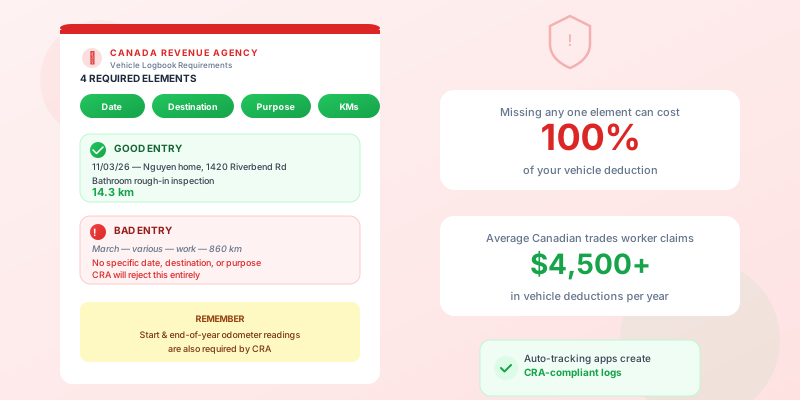
According to CRA motor vehicle records requirements, you must record the date, destination, purpose, and kilometres for each trip. For mixed trips, your mileage logbook should include:
1. The business purpose Same as any trip. “Client meeting with ABC Ltd.”
2. The route taken If you made personal stops, note them. “Via downtown pickup.”
3. The business kilometres claimed Either the direct route distance, or your total minus the personal detour.
4. How you calculated it A note explaining your math. “Direct route 45 km; actual 58 km due to hockey pickup; claiming 45 km.”
If you’re using an automatic mileage tracking app, it captures your actual route via GPS. You then classify the trip and add notes. For mixed trips, the note explains what portion is business.
The goal: If the CRA ever asks, you can demonstrate exactly how you calculated your deduction. Transparency is your shield.
Multi-Day Business Trips
Business travel that spans multiple days has its own complexities.
You drive to a conference in Montreal. The conference runs Monday through Wednesday. You decide to stay through the weekend and explore Old Montreal with your spouse.
What’s deductible?
The CRA allows travel expenses when the trip is primarily for business. If your trip was mainly for business but you added personal days, you can generally deduct the travel to and from the destination—but not the expenses incurred during personal activities.
For multi-day trips, compare business days to personal days. More business days = primary purpose is business. But personal days don’t generate deductible expenses. If you drive around sightseeing on Saturday, those kilometres aren’t business kilometres.
For a typical business trip:
- Travel to/from the destination: Deductible (if primarily business)
- Kilometres during business activities: Deductible
- Kilometres during personal activities: Not deductible
Update your logbook daily. Don’t try to reconstruct a week of driving from memory.
Quick Reference: Gray Area Scenarios
| Situation | Deductible? | Notes |
|---|---|---|
| Gas stop on a business trip | Yes | Incidental, don’t subtract |
| Tim Hortons along your route | Yes | Minor stop, don’t subtract |
| Dry cleaning 8 km out of way | Partial | Subtract the personal detour |
| Scenic route (15 extra km) | Partial | Deduct direct route distance |
| Hockey pickup mid-trip | Partial | Subtract personal kilometres |
| Lunch with friend on business trip | Depends | If secondary to business purpose, OK |
| Shopping trip with quick client stop | Partial | Only business portion |
| Conference + weekend sightseeing | Partial | Travel maybe; personal days no |
The Right Mindset
Here’s how to think about it:
Would you have driven these kilometres anyway for business?
If yes, they’re deductible.
If you drove extra kilometres only for personal reasons, those extras aren’t deductible.
A 90 km round-trip to a client is deductible. Stopping for gas doesn’t change that. Using a restroom doesn’t change that.
But if you drove 15 km out of your way to drop off a package at your brother’s house, those 15 km are personal.
It really is that simple.
What You Should Do
1. Log every trip, even the messy ones. Skipping a trip because it’s “complicated” means leaving money on the table. Log it and figure out the business portion.
2. Note the primary purpose right away. Don’t wait until tax season to remember why you made a trip. Document it the same day.
3. Use direct-route distance for mixed trips. When personal detours are involved, use what the trip would have been without the personal stop.
4. Keep notes on your calculations. If you had to do math, explain it. “Direct route 40 km, claimed 40 even though actual was 48 due to personal errand.”
5. Be consistent. Pick a method for handling mixed trips and stick with it all year. Inconsistency invites questions.
The Bottom Line
Life doesn’t sort itself into clean business and personal buckets. You’ll have trips that are part business, part personal, and part “I’m not entirely sure.”
The CRA understands this. They’re not expecting you to account for every 0.1 km deviation.
What they are expecting: That you make a reasonable effort to separate business from personal, that you claim only the business portion, and that you can explain your method if asked.
Stop for gas? Don’t worry about it. Grab a coffee on the way? You’re fine. 8 km detour for dry cleaning? Subtract it. Shopping trip with a client meeting tacked on? Split it properly.
Track your trips with an automatic mileage tracking app, add notes on mixed trips, and be honest about what’s business and what’s not.
The gray areas aren’t that scary once you understand the rules. Most of the time, the answer is common sense.
Disclaimer: This article is for informational purposes only and does not constitute tax, legal, or financial advice. CRA rules and interpretations can change. Consult a qualified tax professional for advice specific to your circumstances.