

Every year, the Canada Revenue Agency publishes per-kilometre rates that determine how much you can deduct — or how much your employer can reimburse you tax-free — for business driving. Here’s the complete picture.
2026 CRA Mileage Rate
The CRA automobile allowance rate for 2026 is 73 cents per kilometre for the first 5,000 business kilometres, and 67 cents for each additional kilometre. If you drive in the Territories (Yukon, NWT, or Nunavut), the rates are 77¢ and 71¢ respectively.
This is a 1¢ increase over 2025, reflecting continued rises in fuel and vehicle operating costs.
Complete CRA Rate History (2020–2026)
| Year | First 5,000 km | Each additional km | Territories (first 5,000) | Territories (additional) |
|---|---|---|---|---|
| 2026 | 73¢ | 67¢ | 77¢ | 71¢ |
| 2025 | 72¢ | 66¢ | 76¢ | 70¢ |
| 2024 | 70¢ | 64¢ | 74¢ | 68¢ |
| 2023 | 68¢ | 62¢ | 72¢ | 66¢ |
| 2022 | 61¢ | 55¢ | 65¢ | 59¢ |
| 2021 | 59¢ | 53¢ | 63¢ | 57¢ |
| 2020 | 59¢ | 53¢ | 63¢ | 57¢ |
Use our free mileage calculator to see your exact deduction based on your annual driving.
Why There Are Two Rates
The CRA’s two-tier system recognizes that the first 5,000 km cost more per kilometre to operate — insurance, registration, and depreciation hit harder when spread over fewer kilometres. After 5,000 km, those fixed costs are already covered, so the variable rate drops.
Example: If you drive 12,000 business kilometres in 2026:
- First 5,000 km × 73¢ = $3,650
- Next 7,000 km × 67¢ = $4,690
- Total deduction: $8,340
How to Claim: Employees vs. Self-Employed
Employees (T2200 + T777)
If you use your personal vehicle for work and your employer doesn’t reimburse you (or reimburses less than the CRA rate), you can claim motor vehicle expenses on your tax return.
Requirements:
- Your employer must sign a T2200 (Declaration of Conditions of Employment) confirming you’re required to use your own vehicle
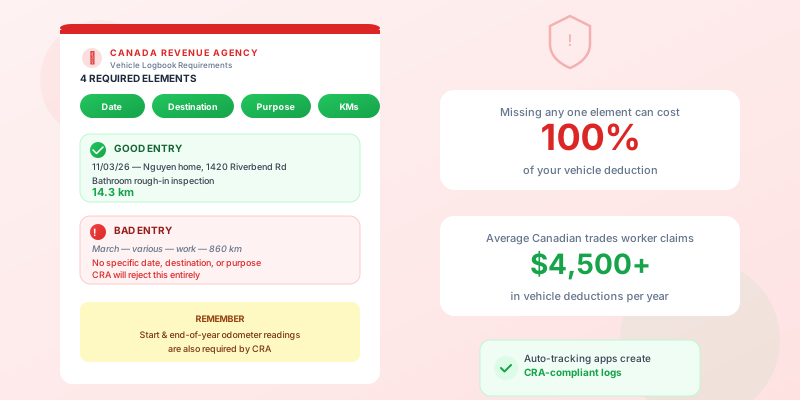
- Keep a detailed mileage logbook with date, destination, purpose, and kilometres for every trip
- File using T777 (Statement of Employment Expenses)
Self-Employed (T2125)
Self-employed individuals claim vehicle expenses directly on T2125 (Statement of Business or Professional Activities). You have two options:
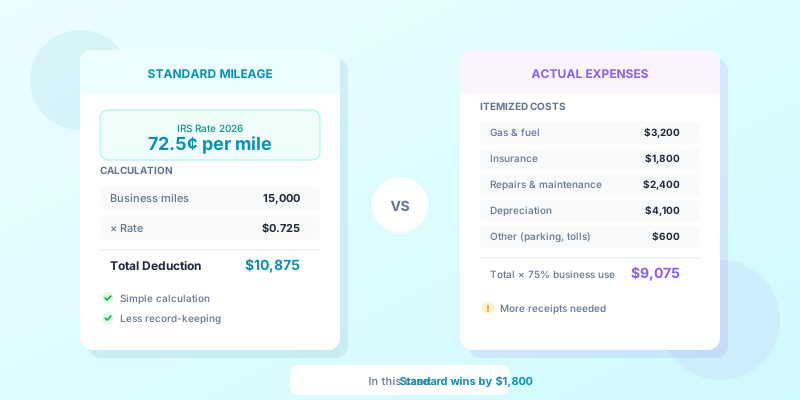
Actual expense method — track all vehicle costs (gas, insurance, repairs, depreciation/CCA) and multiply by your business-use percentage from your logbook. Unlike employees, self-employed individuals cannot use the CRA per-kilometre rate as a flat deduction — you must calculate actual costs.
Either way, you need a logbook. The CRA won’t accept a claim without one.
The Simplified Logbook Method
You don’t have to track every trip forever. The CRA’s simplified logbook method works like this:
- Base year: Keep a full, detailed logbook for one complete 12-month period
- Sample years: Each following year, keep a logbook for any continuous 3-month period
- Comparison: If your business-use percentage during the sample period is within 10 percentage points of the same period in your base year, you can use your base year percentage for the full year
This saves significant effort once you have a base year established. OdoAlibi makes your base year easy — it tracks every trip automatically, so your first year of records becomes your reference forever.
What Your Logbook Must Include
The CRA requires these details for every business trip:
- Date of the trip
- Destination (where you drove)
- Purpose of the trip (client name, job site, delivery, etc.)
- Kilometres driven
You also need:
- Odometer readings at the start and end of the tax year
- Total personal and business kilometres so you can calculate your business-use percentage
See our guide on what the CRA actually wants in a mileage log for real examples of logs that pass audits and logs that don’t.
The GST/HST Angle
If your business is registered for GST/HST, you can claim input tax credits (ITCs) on the GST/HST portion of your vehicle expenses. This is calculated based on the same business-use percentage from your logbook. Many people miss this — it’s extra money on top of your income tax deduction.
How OdoAlibi Handles CRA Mileage Tracking
OdoAlibi automatically records every required field — date, destination, purpose, and kilometres — using GPS. Swipe to classify trips as business or personal, and export a CRA-compliant logbook for your accountant or to attach to your T2125 or T777.
Free with 30 trips per month. Start tracking →