
Sarah is a project manager for a mid-size engineering firm in Calgary. She drives her own car to client sites, subcontractor meetings, and project inspections — easily 15,000 kilometres a year beyond her regular commute. Her employer pays her a flat $300 per month “car allowance” regardless of how much she actually drives.
Every April, she wonders: can I deduct any of this on my taxes?
The answer is complicated. And it’s different from what most people expect.
The Short Answer
Most salaried employees in Canada cannot deduct vehicle expenses on their personal tax return — unless their employer signs a specific form.
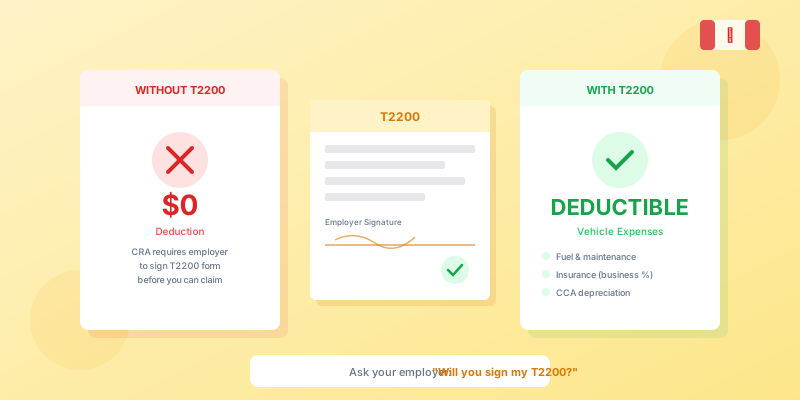
That form is the T2200 — Declaration of Conditions of Employment. Without it, your vehicle expenses are not deductible. Period. The best logbook in the country won’t help you.
But the T2200 isn’t automatic. Your employer has to agree to sign it, and the conditions of your employment have to meet certain criteria.
Let’s break down who qualifies, what you can claim, and what to do if your employer won’t cooperate.
Who CAN Deduct Vehicle Expenses as an Employee?
The CRA allows employees to deduct motor vehicle expenses if ALL of the following are true:
-
You were required to use your personal vehicle for work — not just allowed to, but required to as a condition of your employment.
-
Your employer signed a T2200 confirming that requirement.
-
You were not fully reimbursed for your vehicle expenses. If your employer paid you back for every kilometre at a reasonable rate, there’s nothing to deduct.
-
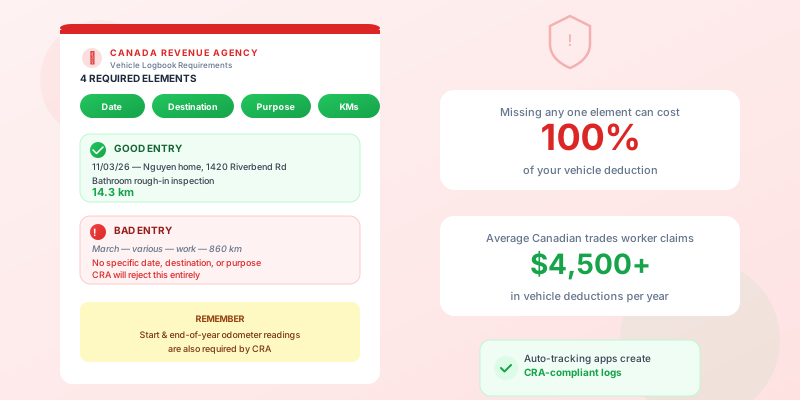
You kept records — a vehicle logbook showing date, destination, purpose, and kilometres for every business trip.
This covers a lot of workers: sales representatives required to visit clients, consultants who travel to project sites, field service technicians, healthcare workers visiting patients, and many others.
Commission employees have slightly broader deduction rights (they can deduct a wider range of expenses on Form T777), but the T2200 requirement is the same.
Transport employees — like long-haul truckers and couriers — have their own rules under the T2200, including the ability to deduct meal costs beyond standard allowances.
For complete details, see the CRA’s T4044 Employment Expenses guide.
But here’s the key point: without the T2200, none of these categories matter. The form is the gateway.
The T2200: Why It’s Essential
The T2200 is a form your employer fills out — not you. It’s a declaration that says:
- Yes, this employee was required to work away from our office
- Yes, they were required to use their own vehicle
- No, we did not fully reimburse them for vehicle expenses (or we paid them a taxable allowance)
- Here’s what we did or didn’t pay them
Your employer signs it. You keep it. You don’t attach it to your tax return, but you must have it in your records if the CRA asks.
What happens without a T2200:
If you claim vehicle expenses without a T2200 on file, and the CRA reviews your return, they will ask for the form. If you can’t produce it — or if your employer refuses to sign one — your deduction will be disallowed. You’ll owe the tax you tried to save, plus interest.
Some people try to claim vehicle expenses anyway, figuring no one will check. Sometimes they’re right. But the CRA specifically flags employment expense claims for review because they’re commonly abused. The T2200 is the first thing they ask for.
Reasonable vs. Taxable Allowances
Not all employer vehicle payments are created equal. The tax treatment depends on whether the allowance is “reasonable.”
Reasonable Allowances (Tax-Free)
A reasonable per-kilometre allowance is based solely on the number of business kilometres you drive. The CRA publishes prescribed rates each year that employers can use as a benchmark:
2026 CRA prescribed rates:
- 73 cents per kilometre for the first 5,000 business km
- 67 cents per kilometre for each additional km
- (77¢ and 71¢ in Yukon, NWT, and Nunavut)
If your employer reimburses you at or near these rates and the allowance is based solely on business kilometres, the reimbursement is tax-free. It won’t appear on your T4. You can’t deduct anything further because you’ve already been made whole.
This is the ideal situation. You get money for your kilometres, it’s not taxable, and the paperwork is simple.
Taxable Allowances (Flat-Rate Car Allowances)
A flat allowance — like Sarah’s $300/month regardless of kilometres — is considered taxable income. It gets added to your T4 in Box 14 and you pay income tax on it.
Why? Because there’s no connection to actual business use. Someone who drives 100 km a month gets the same $300 as someone who drives 2,000 km. The CRA treats this as extra salary, not reimbursement.
If your allowance is taxable, you CAN potentially deduct your actual vehicle expenses — but only if:
- Your employer signs a T2200 confirming you were required to use your own vehicle
- You track your business kilometres and actual vehicle costs
- You file a T777 with your tax return
In this scenario, you’re taxed on the $3,600 allowance (12 × $300), but you can deduct your actual business portion of vehicle expenses, which might be more than $3,600.
Mixed Situations
Some employers pay a per-kilometre rate and provide a flat allowance. Or they reimburse for some expenses but not others. These get complicated fast.
General rule: If any part of your allowance is unreasonable (not based on kilometres) or inadequate (well below the CRA rate), you may be able to claim the shortfall. But you’ll need a T2200 that accurately describes what you received.
What Expenses You Can Claim (Form T777)
If you have a valid T2200 and you weren’t fully reimbursed, you claim your vehicle expenses on Form T777 — Statement of Employment Expenses.
The CRA lists allowable motor vehicle expenses as:
What counts:
- Fuel and oil
- Insurance
- License and registration
- Maintenance and repairs
- Lease payments (with limits)
- Interest on a car loan (with limits)
- Capital cost allowance (CCA) — depreciation on a vehicle you own
What doesn’t count:
- Parking at your employer’s office (that’s a commute expense)
- Fines and tickets
- The purchase price of the vehicle directly (you claim CCA instead)
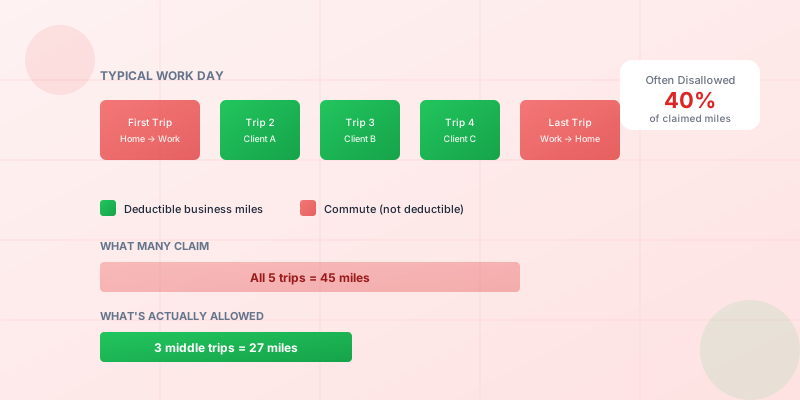
You deduct the business-use percentage of these expenses. The CRA specifies that “if you use a motor vehicle for both employment and personal use, you can deduct only the percentage of expenses related to earning income” — and driving between home and work is considered personal use. If your logbook shows 60% business use, you deduct 60% of your fuel, insurance, etc.
How to calculate your business-use percentage:
- Record your odometer on January 1 and December 31
- Calculate total kilometres driven for the year
- Add up your business kilometres from your logbook
- Divide business km by total km = your business-use percentage
This is the same calculation self-employed Canadians use, and the same CRA logbook requirements apply.
Getting Reimbursed Is Better Than Deducting
Here’s something a lot of employees don’t realize: getting reimbursed by your employer is almost always better than claiming a deduction yourself.
Why?
-
Cash now vs. tax savings later. A reimbursement puts money in your pocket immediately. A deduction reduces your taxable income at tax time — and only saves you your marginal tax rate (maybe 30-40%) of the expense, not the full amount.
-
Simpler paperwork. If your employer reimburses you at a reasonable rate, you don’t need a T2200, you don’t need to track actual expenses, and you don’t need to file a T777. Just track your kilometres, submit them to your employer, and get paid.
-
Lower risk. The CRA scrutinizes employment expense deductions. They do not scrutinize reasonable mileage reimbursements (because they’re tax-free and don’t appear on your return).
-
Employer benefits too. Reasonable vehicle reimbursements are a business expense for your employer, deductible against their corporate income. And unlike salary, they don’t trigger payroll taxes (CPP, EI).
Bottom line: If your employer isn’t reimbursing you properly, your first move should be asking for reimbursement — not figuring out how to deduct expenses yourself.
How to Ask Your Employer for Proper Reimbursement
Most employers aren’t trying to shortchange you. They often just don’t know the rules, or they’ve defaulted to a flat allowance because it’s administratively simpler.
Here’s how to have the conversation:
1. Know the numbers. Track your business kilometres for a month or two. Multiply by the CRA rate. Show your employer the gap between what you drive and what you’re getting.
Example: “I drove 1,200 business kilometres last month. At 73 cents per kilometre, that’s $876. My car allowance is $300. I’m absorbing $576 a month out of my own pocket.”
2. Explain the tax situation. Many employers don’t realize that flat allowances are taxable to employees. Point out that a per-kilometre reimbursement is actually more tax-efficient for everyone.
3. Propose a solution. Suggest switching to a per-kilometre reimbursement system. Offer to track your kilometres with an automatic mileage tracking app and submit monthly reports.
4. If they say no, ask for a T2200. If your employer won’t increase reimbursement but confirms you’re required to use your own vehicle, they should be willing to sign a T2200 so you can at least claim the deduction yourself.
What If Your Employer Won’t Sign the T2200?
This is where it gets frustrating.
Some employers refuse to sign the T2200 because:
- They think it exposes them to liability (it doesn’t — it’s just a factual declaration)
- Their HR department has a blanket policy against it
- They don’t want to admit that vehicle use is “required” (even though it obviously is)
Your options:
1. Push back with documentation. Show your employer in writing that vehicle use is a condition of your job. Point to your job description, your duties, the locations you’re expected to visit. If you literally cannot do your job without driving your own car, that’s “required.”
2. Escalate internally. If HR says no, try your manager. Or try the finance department, who may understand the tax implications better.
3. Check your employment contract. Some contracts explicitly state that you must have a vehicle. That’s evidence of a requirement.
4. Understand the legal landscape. Unlike some US states (California, Illinois), Canadian provinces do not have employment standards laws requiring mileage reimbursement. However, if your employment contract promises reimbursement and you’re not receiving it, that’s a breach of contract worth discussing with an employment lawyer.
5. Document everything. If you can’t get a T2200 this year, keep records anyway. Situations change. Employers change their minds. Having a logbook ready means you can claim deductions the moment you get that form signed.
6. Consider whether this job is costing you. Seriously. If you’re driving 20,000 business kilometres a year and your employer won’t reimburse you or sign a T2200, you’re subsidizing their business with your own money. At 73¢/km, that’s $14,600 a year. Factor that into your compensation when comparing job offers.
Sarah’s Situation: What Should She Do?
Let’s go back to Sarah, the project manager with the $300/month car allowance.
Her allowance is flat, so it’s taxable. She drives about 15,000 business kilometres a year. Her actual vehicle expenses (fuel, insurance, maintenance, lease) total around $9,500.
Option A: Accept the status quo She pays tax on $3,600 in allowance income. She absorbs approximately $6,000+ in unreimbursed vehicle costs. Net loss: significant.
Option B: Get proper per-kilometre reimbursement She asks her employer to switch to 73¢/km. At 15,000 km, that’s $10,950/year — tax-free. Her employer can deduct this as a business expense. Everyone wins.
Option C: Get a T2200 and deduct If her employer won’t change the reimbursement but will sign a T2200, Sarah can claim her actual vehicle expenses. With a 70% business-use percentage (15,000 business km out of maybe 21,000 total), she could deduct about $6,650 of her vehicle costs. At a 35% marginal tax rate, that saves her roughly $2,300 — which doesn’t fully offset her out-of-pocket costs, but helps.
Option B is best. Option C is a fallback. Option A is leaving money on the table.
The Bottom Line
If you’re a salaried employee in Canada driving your personal vehicle for work, here’s the hierarchy:
-
Best: Get reimbursed at the CRA per-kilometre rate. Tax-free, simple, immediate.
-
Second best: If you can’t get full reimbursement, get your employer to sign a T2200 so you can deduct your actual vehicle expenses on Form T777.
-
Worst: Accept a flat car allowance that’s taxable and doesn’t cover your costs, with no T2200 to claim deductions.
The T2200 is the key. Without it, there is no deduction for employees — no matter how many kilometres you drive or how detailed your records are.
If your employer is requiring you to use your car but won’t sign the form, that’s a problem worth solving. The money at stake is real.
Start tracking your business kilometres today with our automatic mileage tracking app — whether you’re building a case for reimbursement or preparing to claim a T2200-backed deduction, you’ll need the records either way.