

“Contemporaneous.”
It’s the one word that can make or break your mileage deduction. I’ve seen clients lose thousands of dollars in Tax Court because their logs weren’t contemporaneous—even though they had every trip recorded.
The problem? They created the log in March from memory, not throughout the year as they drove.
Let me explain exactly what the IRS means by “contemporaneous,” why it matters more than most people think, and how to make sure your mileage records actually qualify.
What Does “Contemporaneous” Actually Mean?
In plain English: recorded at or near the time of the trip.
The IRS doesn’t define an exact timeframe. But from court cases and auditor guidance, we know what passes and what doesn’t:
| Recording Method | Contemporaneous? |
|---|---|
| Logged same day | Yes |
| Logged within a week | Generally yes |
| Logged at end of month | Borderline—depends on detail |
| Reconstructed months later | No |
| Created at tax time from memory | Definitely no |
The idea is simple: human memory is unreliable. A log created six months after the fact is more likely to have errors, round numbers, and missing trips than one recorded in real time.
Why the IRS Requires Contemporaneous Records
This isn’t bureaucratic pettiness. The contemporaneous requirement exists because the mileage deduction is heavily abused.
Consider these numbers:
- The IRS estimates 30-40% of mileage deductions are overstated
- Mileage fraud costs the government billions annually
- Audit adjustments for vehicle expenses are common
When you claim the standard mileage rate (72.5¢/mile in 2026), you’re essentially telling the IRS: “Trust me, I drove this much for business.” The contemporaneous record is the evidence that backs up that trust.
Without it, your deduction is just a number on a form.
The Legal Standard: IRC Section 274(d)
If you want to get technical—and you should, because this is what auditors reference—here’s where the requirement comes from.
Internal Revenue Code Section 274(d) requires “adequate records” for vehicle expenses. Treasury Regulation 1.274-5T(c)(2) specifies that these records should be made “at or near the time of the expenditure or use.”
The regulation states:
“A contemporaneous log is not required, but a record of the elements of an expenditure or of a business use of listed property made at or near the time of the expenditure or use, supported by sufficient documentary evidence, has a high degree of credibility not present with respect to a statement prepared subsequently.”
Translation: You don’t technically need a log made at the exact moment of each trip. But records made later have “less credibility” and are easier for the IRS to challenge.
What Happens When Logs Aren’t Contemporaneous
Tax Court is full of cases where taxpayers lost mileage deductions because their records failed the contemporaneous test. Here are the patterns:
Pattern 1: Round Numbers
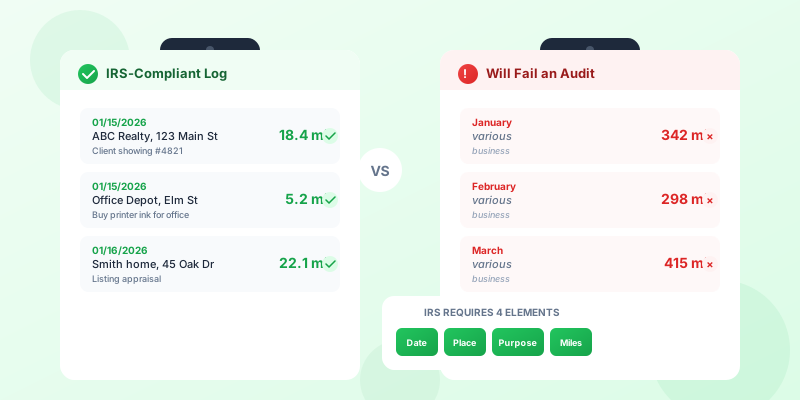
A log showing “20 miles, 20 miles, 25 miles, 20 miles” looks estimated. Real GPS-tracked trips have numbers like 18.4, 22.7, 19.1. Round numbers signal reconstruction.
Pattern 2: Identical Descriptions
“Client meeting. Client meeting. Client meeting.” If every trip has the same generic description, it looks like batch entry. Real logs have variety: “Listing presentation at 123 Oak St,” “Showing to Rodriguez family,” “Final walkthrough before closing.”
Pattern 3: Missing Details
“Business trip, 30 miles.” Where did you go? Who did you meet? Why was it business-related? Vague entries suggest the taxpayer doesn’t actually remember—because they didn’t record it at the time.
Pattern 4: The Tax-Time Dump
An auditor can often tell when a log was created all at once. The formatting is too consistent. The dates are suspiciously complete. There are no gaps or corrections. Real logs have character—crossed-out entries, varying handwriting, occasional gaps filled in later with notes.
How to Create Genuinely Contemporaneous Records
You have three options, ranked from best to worst:
Option 1: Automatic Mileage Tracking App (Best)
Apps like OdoAlibi use GPS to record trips automatically as you drive. The timestamp, route, and distance are captured in real time—no manual entry, no memory required.
This is the gold standard for contemporaneous records. The IRS can’t argue that a GPS log with timestamps was created after the fact.
Option 2: Manual Logging, Same Day
If you prefer a paper logbook or spreadsheet, record each trip the same day you drive it. Keep the logbook in your car. Update it at each stop or at the end of each workday.
The key: don’t let entries pile up. Friday afternoon catch-up sessions are fine. March catch-up sessions are not.
Option 3: Weekly Reconciliation
At minimum, review and complete your log weekly. Fill in any missing details while the trips are still fresh. This is borderline contemporaneous—acceptable for most auditors, but you’re relying on memory that degrades quickly.
What About Reconstructed Logs?
Can you ever reconstruct mileage from the past? Yes, but with significant caveats.
The IRS will accept reconstructed records if:
- You have other evidence supporting the trips (calendar entries, emails, receipts from destinations)
- The reconstruction is based on routine patterns that can be verified
- You’re honest that it’s a reconstruction and not a contemporaneous record
Our guide on recovering past mileage from your phone walks through this process. Google Timeline, calendar data, and email records can support a reconstruction—but it’s always weaker than a contemporaneous log.
The Contemporaneous Requirement for Different Taxpayers
The standard applies differently depending on how you claim the deduction:
Self-Employed (Schedule C)
Full contemporaneous records required for every business trip. At 72.5¢/mile, 15,000 business miles = $10,875 deduction. The IRS scrutinizes these claims closely.
Employees Getting Reimbursed
Your employer should require contemporaneous records before reimbursing mileage. This protects both of you—the employee can’t deduct what wasn’t tracked, and the employer has documentation if audited.
Medical or Charitable Mileage
Same contemporaneous standard applies, though the rates are lower (20.5¢ for medical/moving, 14¢ for charity in 2026). These deductions are less common, so they sometimes receive less audit attention—but the documentation requirement is identical.
Red Flags That Trigger Audits
Certain patterns make the IRS suspicious that a log isn’t contemporaneous:
- High mileage relative to income — Claiming $15,000 in mileage deductions on $40,000 of self-employment income raises questions
- Round numbers throughout — Real driving produces odd mileages
- No personal use — Everyone drives personally sometimes. A log showing 100% business use looks unrealistic
- Mileage exceeds plausible total — If you claim 30,000 business miles but your car’s annual odometer change is 25,000, you have a problem
The Bottom Line
A contemporaneous mileage log is one created at or near the time you drive—not reconstructed later from memory.
The IRS requires this because memory fades and humans overestimate. A log created in real time is credible. A log created at tax time is suspicious.
The easiest way to guarantee your records are contemporaneous? Use automatic tracking. When every trip is GPS-logged with a timestamp, there’s no question about when it was recorded.
Your mileage deduction at 72.5¢/mile is real money. Don’t risk losing it to a technicality that’s completely avoidable.
FAQ
Does the IRS accept mileage logs from apps?
Yes. The IRS accepts digital records from mileage tracking apps as long as they contain the required trip details (date, destination, purpose, miles). GPS-tracked logs with timestamps are especially credible because they’re inherently contemporaneous.
How long do I need to keep mileage records?
Keep records for at least three years from the date you file the return claiming the deduction. If you file early, count from the April deadline. For a 2026 tax return filed in March 2027, keep records until at least April 2030.
Can I recreate a mileage log from my calendar?
You can use calendar entries to support a reconstructed log, but it won’t have the same credibility as a contemporaneous record. The reconstruction should be based on documented patterns and supported by other evidence like emails or receipts.
What if I forgot to track some trips?
For occasional forgotten trips, you can add them later with a note that the entry is reconstructed. For large gaps, consider what supporting evidence you have (calendar, emails, Google Timeline). Going forward, use automatic tracking to prevent future gaps.
Is a spreadsheet considered contemporaneous?
A spreadsheet can be contemporaneous if you update it at or near the time of each trip. The file’s modification history may be examined in an audit. An app with GPS timestamps provides stronger evidence than a self-reported spreadsheet.