
A plumber in Edmonton got reviewed by the CRA in 2024. He’d driven 38,000 kilometres that year and claimed 28,000 of them as business. He had a spreadsheet. It had monthly totals, a column that said “work,” and nothing else.
The CRA disallowed the entire claim. Not part of it. All of it.
He didn’t lose because he was lying. He lost because his log didn’t actually prove anything. The CRA looked at his spreadsheet, saw no dates, no destinations, no trip-level detail, and concluded there was no reliable way to verify the claim.
His accountant told him afterward: “If you’d just written down where you went each day, you’d have kept every dollar.”
That’s the whole game with CRA vehicle logs. The bar isn’t high. But you have to clear it.
Canada Has Its Own Rules (And They’re Different From the US)
If you’ve ever Googled “mileage log template” you’ve probably found American advice. The IRS and CRA have similar requirements, but Canada adds a few layers that catch people off guard.
What’s different in Canada:
- Self-employed Canadians must track actual vehicle expenses — not a flat per-kilometre deduction. The CRA’s per-kilometre rates (73 cents for the first 5,000 km, 67 cents after that in 2026) only apply to employee reimbursement. If you’re self-employed, your logbook determines the percentage of actual costs (fuel, insurance, maintenance, lease, CCA) you can deduct.
- The simplified logbook method lets you keep a full log for one “base year,” then only a three-month sample in future years. No equivalent exists in the US.
- Employees need a signed T2200 from their employer before claiming any vehicle expenses. Your log means nothing without it.
- GST/HST input tax credits depend on your business-use percentage. A weak log means lost ITCs on top of lost deductions.
Your vehicle log isn’t just supporting a single deduction line. It’s the foundation for multiple claims across your return.
What Must Be in Every Single Entry
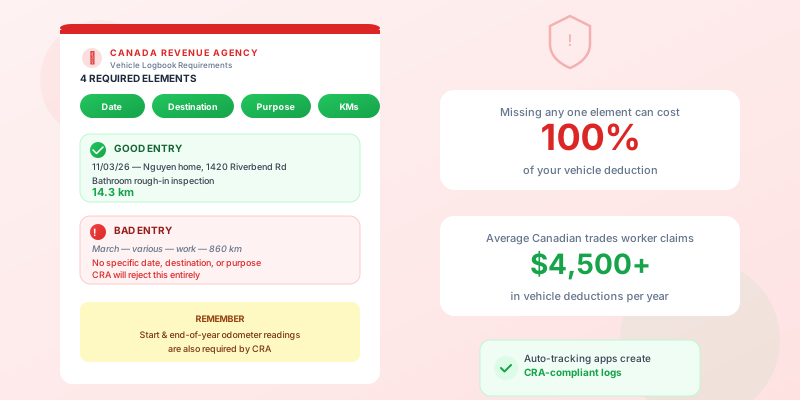
The CRA requires four elements per trip, drawn from IT-521R and the Income Tax Act:
- Date — The specific day. January 15, not “mid-January.”
- Destination — A name and location. “Kim’s Plumbing Supply, 45 Jasper Ave, Edmonton” — not “supply run.”
- Business purpose — Why you went. “Pick up copper fittings for Nguyen bathroom reno” — not “supplies.”
- Kilometres — The actual distance for that trip. Not a daily total, not an estimate.
Skip any one of these on a significant number of entries and the CRA can reject the entire log.
Two Logs That Tell the Same Story Differently
Here’s a plumber who drove to the same three places on the same Tuesday. One log survives a CRA review. The other doesn’t.
Log A: The one that works
| Date | From | To | Purpose | KM |
|---|---|---|---|---|
| Tue 11/03/26 | Home (office) | Nguyen residence, 1420 Riverbend Rd, Edmonton | Bathroom reno — rough-in inspection | 14.3 |
| Tue 11/03/26 | 1420 Riverbend | EMCO Supply, 9705 45 Ave, Edmonton | Pick up copper fittings for Nguyen job | 8.7 |
| Tue 11/03/26 | EMCO Supply | Home (office) | Return — no more site visits today | 17.1 |
Why it works: Real addresses. Specific client name. Job description tied to the trip. Kilometres with decimals. A clear narrative anyone could follow.
Log B: The one that doesn’t
| Date | Destination | Purpose | KM |
|---|---|---|---|
| March | Job sites | Work | 860 |
Why it fails: This is a monthly total with no trip-level detail. The CRA can’t verify a single kilometre.
The gap between these two logs is about 30 seconds of effort per trip.
The “Business-Use Percentage” and Why It Matters More in Canada
In the US, many self-employed people use a flat per-mile rate. In Canada, you calculate a business-use percentage and apply it to your actual vehicle costs.
Here’s how it works:
Step 1: Record your odometer on January 1 and December 31.
- January 1: 42,310 km
- December 31: 67,890 km
- Total driven: 25,580 km
Step 2: Add up all business kilometres from your log.
- Total business: 18,200 km
Step 3: Calculate the percentage.
- 18,200 ÷ 25,580 = 71.1% business use
Step 4: Apply that percentage to every vehicle expense.
- Fuel: $4,800 × 71.1% = $3,413
- Insurance: $2,400 × 71.1% = $1,706
- Maintenance: $1,200 × 71.1% = $853
- Lease payments: $6,000 × 71.1% = $4,266
- Total deduction: $10,238
If your log is sloppy and the CRA cuts your business-use percentage from 71% to 50%, you lose over $3,000 in deductions. If they reject the log entirely, you lose all $10,238.
This is why Canadian taxpayers can’t afford a weak log. It’s not just about kilometres — it’s the multiplier for every vehicle expense you claim.
Don’t forget the odometer photos. Take one on January 1 and December 31 (or the start/end dates you used the vehicle for business). This takes 10 seconds and proves your total annual distance. Without it, the CRA has no way to validate your percentage.
The Simplified Logbook Method: Your Base Year Shortcut
Canada offers something unique: after keeping a complete logbook for one full year (your “base year”), you can switch to tracking just a three-month sample period in subsequent years.
How it works:
- Year 1 (base year): Track every trip, all year. Your business-use percentage comes out to, say, 71%.
- Year 2 and beyond: Track every trip for any three consecutive months. Your sample period shows, say, 68%.
- Compare: If your sample is within 10 percentage points of your base year (61%–81% in this case), you can use the base year percentage for the full year.
When it falls apart:
- Your sample period is outside the 10% range — you need a new full base year
- Your driving patterns changed significantly (new job, moved, different clients)
- You didn’t actually complete a proper base year log to begin with
Practical advice: If you use an automatic mileage tracking app, the simplified method doesn’t save you any effort. The app tracks everything regardless. Keep the full data — it’s stronger in a review and gives you flexibility.
What CRA Reviewers Actually Do With Your Log
CRA reviewers aren’t adversarial. They’re checking boxes. Here’s what they look for in practice.
First pass — structure check:
- Does the log have individual trip entries with dates?
- Does each entry have a destination and purpose?
- Are odometer readings recorded for start and end of year?
- Is there a clear business-use calculation?
If any of these are missing, the review gets harder for you immediately.
Second pass — believability:
- Do the kilometres make sense for the destinations? (A reviewer can check distances on Google Maps.)
- Are there entries on weekends or holidays that seem odd for your type of work?
- Do the totals add up correctly?
- Is the business percentage reasonable for your occupation? (A home-based consultant claiming 95% looks different than a delivery driver claiming 95%.)
Third pass — cross-referencing:
- Do logged client visits match your invoices or appointment records?
- Do fuel purchases match the kilometres driven?
- Does the odometer math work? (Total business km + personal km should roughly equal odometer difference.)
- For employees: is there a T2200 on file?
What makes reviewers comfortable:
- Variation in daily kilometres (real driving doesn’t produce identical numbers)
- Days with zero business driving (everyone has them)
- Occasional notes like “took Highway 2 — construction on QE2” (signals real-time recording)
- GPS-timestamped entries from an app (machine-generated records are hard to fabricate)
A Real Week: Landscape Contractor in the GTA
Here’s what a solid log looks like for someone driving across the Greater Toronto Area for work. This is a landscape contractor running a small crew.
Vehicle: 2022 Ford F-150 January 1 odometer: 78,420 km
| Date | From | To | Purpose | KM |
|---|---|---|---|---|
| Mon 05/05/26 | Home (office) | 55 Lakeview Dr, Mississauga | Spring cleanup — Henderson property, crew of 3 | 22.4 |
| Mon 05/05/26 | 55 Lakeview Dr | Sheridan Nurseries, Hwy 10, Brampton | Pick up sod rolls for Henderson job (12 rolls) | 18.9 |
| Mon 05/05/26 | Sheridan Nurseries | 55 Lakeview Dr, Mississauga | Return to Henderson site with materials | 19.2 |
| Mon 05/05/26 | 55 Lakeview Dr | Home (office) | End of day — crew dropped at shop | 23.1 |
| Tue 06/05/26 | Home (office) | 102 Greenfield Cres, Oakville | New client estimate — patio + retaining wall | 31.7 |
| Tue 06/05/26 | 102 Greenfield | 55 Lakeview Dr, Mississauga | Check afternoon progress at Henderson site | 14.8 |
| Tue 06/05/26 | 55 Lakeview Dr | Home (office) | Return | 22.8 |
| Wed 07/05/26 | Home (office) | Halton Ready Mix, 4th Line, Milton | Pick up 2 yards of concrete for Henderson retaining wall | 38.5 |
| Wed 07/05/26 | Halton Ready Mix | 55 Lakeview Dr, Mississauga | Deliver concrete to site | 29.3 |
| Wed 07/05/26 | 55 Lakeview Dr | Home (office) | Return | 22.6 |
| Thu 08/05/26 | — | — | Office day (invoicing, quotes). No driving. | 0 |
| Fri 09/05/26 | Home (office) | 55 Lakeview Dr, Mississauga | Henderson project — final day, sod installation | 22.7 |
| Fri 09/05/26 | 55 Lakeview Dr | Home (office) | Return — Henderson job complete | 23.0 |
Weekly total: 289.0 km (all business)
What makes this log strong:
- Home office as starting point — the contractor does estimates, invoicing, and scheduling from home, establishing it as principal place of business
- Material pickups tied to specific jobs — not just “supply run” but “sod rolls for Henderson”
- Thursday shows zero km — honest, realistic, not every day involves driving
- Slightly different distances for the same route — 22.4, 23.1, 22.8, 22.6, 22.7 to Lakeview Dr on different days. Real routes vary with traffic and stops.
- Crew and material details — extra context that a reviewer can verify against invoices
The T2200: The Form Employees Can’t Skip
If you’re a salaried or hourly employee claiming vehicle expenses, none of this matters without a T2200 — Declaration of Conditions of Employment.
Your employer must sign this form confirming:
- You’re required to use your own vehicle for work
- You’re not reimbursed for the expenses (or only partially)
- You’re required to pay your own vehicle costs
No T2200 = no vehicle expense claim. The best logbook in Canada won’t save you. Get this form signed before you file.
Self-employed Canadians don’t need a T2200. Your logbook and actual expenses flow through your T2125 (Statement of Business Activities).
Recording Methods: What Actually Holds Up
The CRA accepts any format — paper, spreadsheet, app. CRA guide T4002 confirms electronic records are valid. But not all formats are equal when someone’s actually reviewing your claim.
Paper notebook: Works if you’re diligent. The problem is that paper can’t prove when you wrote the entries. A reviewer might wonder if you filled in three months of logs the night before mailing your return. You also can’t back it up easily, and losing the notebook means losing your records.
Spreadsheet: Better for organization and math. Same timestamp problem as paper — there’s no proof of when rows were added. But if your entries are detailed and consistent, most reviewers won’t push back.
Mileage tracking app: The strongest option for one reason: GPS timestamps prove the entry was created at the time of the trip. This is the closest thing to bulletproof contemporaneous recording. If a reviewer questions any entry, the app can show the exact route, the exact time, and the exact distance — generated by the phone’s GPS, not typed by hand.
If your app occasionally misses a trip, you can add it manually. Just do it the same day and note it as a manual entry.
The GST/HST Angle Most People Miss
If you’re GST/HST registered, your vehicle log does double duty.
Your business-use percentage determines how much GST/HST you can claim back as input tax credits (ITCs) on vehicle expenses. A weak log doesn’t just cost you income tax deductions — it costs you ITCs too.
Example: You spent $6,000 on fuel (including $780 in HST). At a 71% business-use rate, you can claim $554 in ITCs. If the CRA reduces your percentage to 50% because your log is inadequate, you lose $164 in ITCs — on fuel alone. Add in insurance, maintenance, and lease payments, and the lost ITCs pile up fast.
Track your kilometres properly and the ITCs take care of themselves.
Five Common Mistakes That Sink Canadian Logbooks
1. Logging monthly totals instead of individual trips. The CRA needs trip-level detail. “March: 860 km” is not a logbook — it’s a guess.
2. Forgetting odometer readings. Without start and end-of-year readings, the CRA can’t verify your total distance or business percentage. Two photos a year. That’s all it takes.
3. Claiming self-employed deductions using the per-kilometre rate. The 73¢/67¢ rates are for employee reimbursement only. Self-employed taxpayers must use actual expenses multiplied by their business-use percentage. Using the wrong method flags your return.
4. No T2200 for employee claims. Employees need their employer to sign this form. Filing without it is filing incomplete — the CRA will ask for it and delay everything.
5. Not recording personal trips. You don’t need detailed personal entries, but the CRA needs to see that your total kilometres (business + personal) roughly matches your odometer. If your log only shows business trips totaling 18,000 km but your odometer shows 25,000, the gap should be personal driving. If the numbers don’t add up, the reviewer will dig deeper.
What to Do This Week
Take an odometer photo. Right now, or the next time you’re in your vehicle. If it’s the start of the year, that’s your baseline. If it’s mid-year, it’s still useful as a reference point.
Look at your last five trips. Could someone who doesn’t know you understand where you went and why? If not, add more detail going forward.
Check your employment status. Self-employed? Make sure you’re tracking actual expenses, not using per-km rates. Employee? Make sure you have a T2200.
Pick a recording method and stick with it. An automatic mileage tracking app is the easiest way to get GPS-verified, timestamped records. But even a consistent spreadsheet beats an inconsistent app.
If you’ve fallen behind on tracking, you can reconstruct past mileage from your phone’s data — but starting now is always better than catching up later.
The Bottom Line
The CRA vehicle log is four things per trip — date, destination, purpose, kilometres — recorded close to when the trip happened. Add two odometer photos per year and you’re ahead of 90% of taxpayers.
The plumber in Edmonton didn’t lose his claim because of bad math. He lost it because he had a spreadsheet full of monthly totals and the word “work.” Thirty seconds of detail per trip would have saved him over $10,000 in deductions.
Your log doesn’t need to be perfect. It needs to be specific enough that a stranger can see where you went, why, and how far you drove.
Use our mileage deduction calculator to see what your tracked kilometres are worth, or start with our free CRA mileage log template if you need a quick way to get compliant today. For automatic GPS tracking that handles all of this for you, try OdoAlibi’s CRA mileage tracker — free with 30 trips per month.